
12 Soldiers of the Revolution
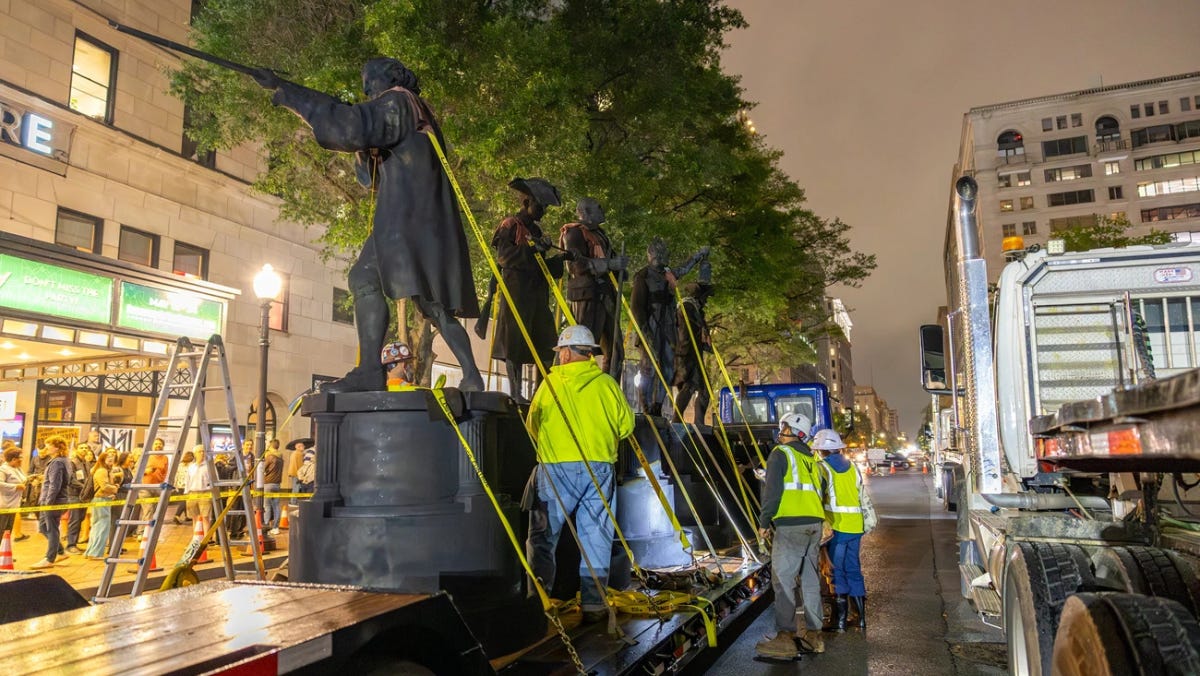
In Washington, there is a remarkable new statue exhibit which helps bring this history alive.
In just a few short weeks, we will celebrate the 250th anniversary of the signing of the Declaration of Independence. It is a good time to revisit the history of how we got here.
Washington D.C. is a good place to learn about, and be reminded of, the amazingly heroic efforts made by ordinary people who believed in extraordinary truths about being endowed by our Creator with inalienable rights including life, liberty and the pursuit of happiness.
In Washington, there is a remarkable new statue exhibit which helps bring this history alive.
If you visit Freedom Park on Pennsylvania Avenue near the Willard Hotel, you will see an amazing Revolutionary War exhibit which honors the Declaration of Independence, the War for Independence, and our 250th Anniversary celebration.
The National Park Service provided a deeply useful introduction to this remarkable exhibit. Reading it, and then visiting the exhibit, will give you surprising insights into the nature of the American Revolutionary Army.
The exhibit of 12 statues of Revolutionary War soldiers is organized around a large statue of Caesar Rodney. This statue became surprisingly controversial during the cycle of political correctness in 2020. It was taken down from Rodney Square because Rodney had owned slaves. It was an act of appeasement to the left since a statue of Christopher Columbus was taken down at the same time.
It was ironic that the left objected to Rodney, because he had fought for a bill to block slaves being imported into Delaware and he had freed his own slaves on his death.
Rodney’s statue had been in Rodney Square since 1923. It commemorated his amazing all-night, 80-mile horse ride from his plantation in Dover to Philadelphia — through a thunderstorm — to cast the deciding vote for Delaware to ratify the Declaration of Independence.
For many years, Rodney’s ride was seen as second only to Paul Revere’s in its patriotic, romantic, and epic qualities. Rodney, who was ill, galloped through a powerful thunderstorm because of the depth of his patriotic commitment to the idea of freedom. His vote broke the tie among the Delaware delegation, and no one doubted that his heroism mattered.
Of course, the Rodney’s of the time did not win the revolution. They started it, but it took thousands and thousands of patriots to win it. This is the point of the 12 soldiers who are on display with Rodney. These statues represent the men who took on the most powerful empire of their time and refused to back down. They endured the hard winter at Valley Forge, frustrating defeats, and incomplete victories. Their courage, commitment, and endurance ultimately made it possible for Gen. George Washington to defeat the British Army and win our independence.
The soldiers organized around Rodney’s equestrian statue honor real soldiers. Half of them are Black. Most Americans do not realize that there were approximately 8,000 Black soldiers fighting for American freedom during the revolution. Some of them were free before the revolution. Others joined in return for a grant of freedom.
These statues deserve your attention because they represent real people. As you visit them, think of the sacrifices they made so you can be free.
Simon Knowles joined the war effort at 15 and fought for eight years.
Caesar Glover was taken from Africa as a slave when he was eight. He enlisted in the Marblehead Men who saved the Continental Army from disaster by moving it in the fog from Brooklyn to Manhattan — and then helped move Washington and the Continental Army across the Delaware River on Christmas Day. He gained his freedom after the war.
Joseph Warren was a medical doctor who sent Paul Revere on his famous ride to announce that the British were coming. He enlisted as a private and was killed at the Battle of Bunker Hill.
Jude Hall escaped from slavery and served from 1775 to 1783 in many major battles. He was called “Old Rock” at Monmouth for his strength and courage.
John Peter Gabriel Muhlenberg was a preacher. He convinced 300 men to enlist in the Continental Army. He served through the victory at Yorktown and then was elected to the first Congress and helped pass the Bill of Rights.
James Armistead Lafayette was born as a slave and turned his status into an asset. He pretended to be a runaway slave so he could be in the headquarters of British Gen. Charles Cornwallis and the traitor Benedict Arnold. He gave them false information while sending reports back to Washington and Lafayette which helped them win the battle of Youngstown. After the war, Lafayette convinced the Virginia legislature to make him a free man and he adopted Lafayette’s name.
Samuel Whittemore was one of the more remarkable of the revolutionaries. He was already 78 when the British attacked the Americans at Concord and Lexington in 1775. He got so angry he pulled out the guns he had used two decades ago in the French and Indian Wars and began attacking British troops. They shot him in the face and bayoneted him 13 times. Not only did he recover, he lived another 18 years and finally died at 96.
Jack Sisson was born a slave but became a volunteer beginning with a risky raid on Newport, Rhode Island. The Rhode Island regiment had native American, Black, and white soldiers. He served all the way through Yorktown.
James Caldwell was a chaplain in the Continental Army. At a crisis point in the battle of Springfield he distributed paper from Isaac Watt’s hymnals to use as wadding for the cannons. The British murdered his wife, but it only made him fight harder. He was finally killed by the British in 1781.
Peter Salem was an emancipated slave who enlisted in the Massachusetts militia and fought in the beginning of the Revolutionary War at Lexington, Concord, and Bunker Hill. He served until 1780 and then went home to Massachusetts and set up a small business.
Naphtali Daggett was a professor at Yale who responded to a British attack on New Haven by leading 100 Yale students against more than 2,000 British soldiers. The British captured Daggett and tortured him with bayonets leaving him so wounded he died a year later.
Salem Poor bought his freedom from slavery before the war. He was so heroic at the battle of Bunker Hill that 14 officers signed a petition asking Congress to recognize his actions. He went on to fight more battles and then went home to live in Boston when the war was over.
If you get to visit Freedom Park, it will help remind you that real people risked their lives, fortunes and sacred honor for our freedom. They fought on real battlefields and endured real hardships. It is a powerful reminder that freedom is never free — and this rule applies to our generation as much as any other era.
Latest from Newt’s World:
You can manage your subscription preferences to choose the updates, newsletters, and alerts you want to receive on the website.


