
Real Change in National Security
The defense system must learn that being uncomfortable is better than being dead.
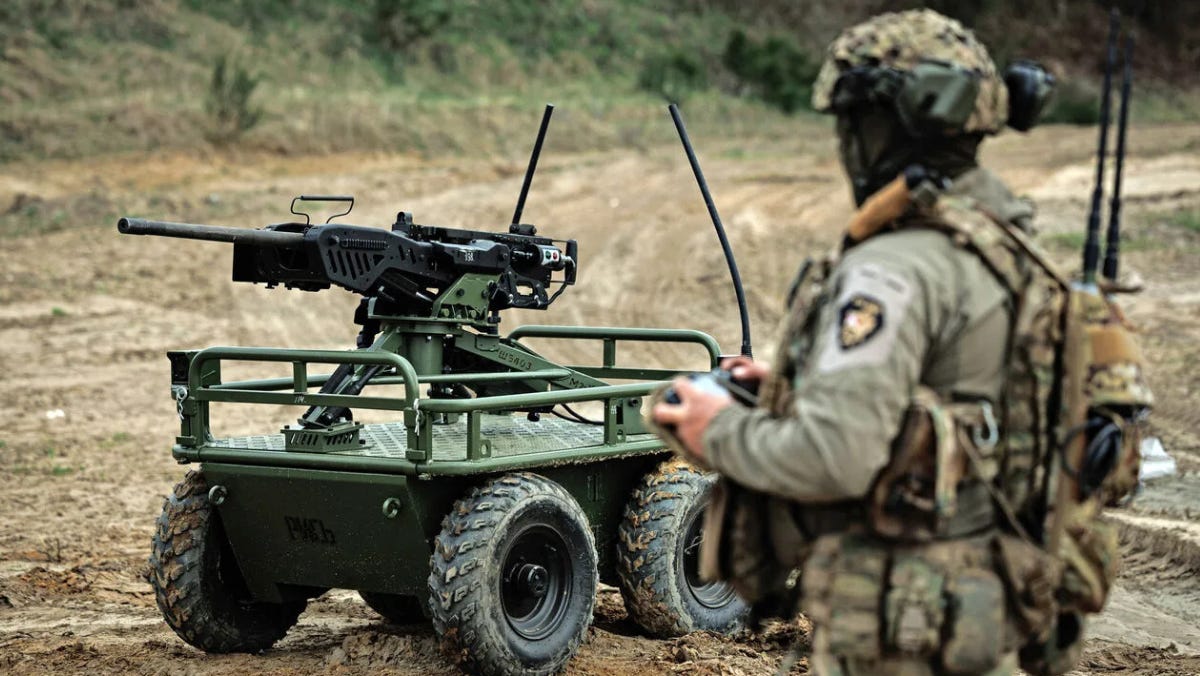
The Ukrainians are using drones and ground robots against Russia. In Iran, both sides are using drones, and we recently used remote piloted boats to rescue downed helicopter pilots. The development of artificial intelligence and innovation is accelerating rapidly.
Every week, Ukraine demonstrates that conventional war patterns of the 20th century are increasingly obsolete. This is true for Russia, but also for America.
There must be real changes to the ponderous, bureaucratic, over-regulated, and lobbyist-dominated Pentagon. A half-century of Congressional micromanagement and pork barrel decisions have made it harder and more expensive to modernize our national security systems. The large, self-sustaining, self-interested bureaucracies have exercised enormous power over our national defense system — and we are less safe for it.
Politicians make good speeches about the importance of change and reform. Then committees are set up to eventually report on change and reform. When faced with the need for significant changes, the Pentagon announces minor tweaks wrapped in big language.
And the badly needed, serious changes don’t happen.
Here are some historic examples that will help us distinguish between small changes and big changes.
During the Civil War, when Abraham Lincoln could not find a general capable of winning in the Eastern theater, he appointed seven new commanders over two years. Six different individuals were picked. Maj. Gen. George McClellan was appointed twice.
In 1906, when Admiral John Fisher introduced the Dreadnought battleship, he ruthlessly decommissioned 154 ships in the Royal Navy. He believed they were no longer survivable in the modern emerging world — and he needed the money to build an expensive new class of battleships, which revolutionized naval warfare.
During World War II, when it was clear that the Commandant of Cavalry and his team could not adjust from horse-based warfare to the tank-based German Blitzkrieg, US Army Chief of Staff Gen. George Marshall simply abolished the post and moved all cavalry functions into the new armored organizations.
In fact, Marshall faced and implemented several major changes. He had a plan for a 200-division army to fight World War II. President Franklin D. Roosevelt informed him that the United States was going to build 50,000 airplanes a year. Roosevelt intuited that airplanes would be vital to winning, and he was determined that the United States would have the scale and the modernity to be the dominant airpower.
Marshall objected that the manpower to build 50,000 planes a year made it impossible to have a 200-division army. The President explained to Marshall that he had to figure out how big an army he could field if we built 50,000 planes. Marshall’s plan dropped from 200 to 89 divisions.
On Oct. 1, 1986, President Ronald Reagan signed the Goldwater-Nichols Act requiring a revolution in jointness among the military branches into law. The bill had been developed beginning with the founding of the Military Reform Caucus in 1981. After five years of work (including a big report by the Center for Strategic and International Studies), the Congress reached a consensus that profound change was necessary. President Reagan, Secretary of Defense Caspar Weinberger, and every active duty four star officer opposed the bill. The evidence of the need for profound change was so great that the Congress moved ahead anyway. Today virtually everyone agrees that jointness was a vitally needed change.
These are examples of real change.
As we watch our national security system wrestle with these emerging realities (including many agencies beyond the Pentagon), we must demand change on the scale that is really needed.
Recent history has taught us a variety of painful lessons — in Iraq, Afghanistan, Iran, and Ukraine to name a few). Our equipment is too expensive. There is too little of it. We cannot keep up with the rate of change happening around us.
Perhaps most importantly, our systems do not plan backward from victory. They plan forward from the comfortable, familiar tools and habits we already have.
Every year that goes by the gap between what we need and what we have grows. The United States has been the most powerful force in the world for eight decades. Now, our past strength may be crippling us from thinking clearly about the future.
We need real change — on a scale that defeats our real challenges.
The defense system must learn that being uncomfortable is better than being dead.
Latest from Newt’s World:
You can manage your subscription preferences to choose the updates, newsletters, and alerts you want to receive on the website.


I agree with Newt. Part of the problem is that in order to get votes in congress to pass defense authorizations it has been necessary to have large military installations, and defense contractors in safe democratic congressional districts and states. If a major change in our force structure requires that procurement is significantly altered from our big defense contractors, this may mean a shift in votes away from defense spending.