


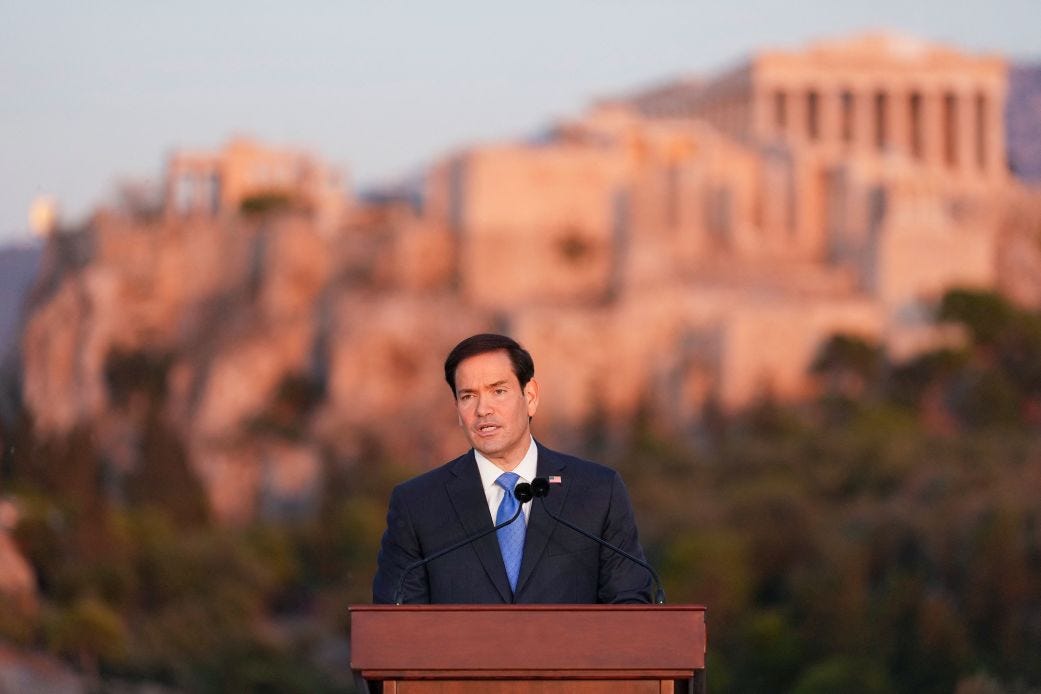
Secretary of State Marco Rubio delivered an extraordinary speech in Athens on Wednesday. He eloquently wove together the remarkable history of Ancient Greece, the lasting power of its civilization, and the challenges our generation faces.
It was thoughtful and extraordinarily compelling. Being delivered with the backdrop of the Acropolis and the Parthenon also gave it an almost cinematic quality.
Callista and I both marveled at the staging and the substance. Sec. Rubio may be the most effective cabinet officer in delivering sympathetic, unifying speeches. Consider his opening appeal to the Greek audience within the framework of his message about the policies America and Europe must develop to remain safe and free:
“The Greeks of antiquity, they seem to have an almost mystical hold on our memory. They call us back to them, again and again.
“480 years before Christ, the armies of Xerxes arrived in this city, and they put its sanctuaries to the torch. Most Athenians had by then evacuated by ship to a nearby island. But there was a handful of them that refused to leave their home. So instead, they barricaded themselves in the rocky fortress of the Acropolis to fight an extraordinary last stand, heaving massive stones down the cliffs onto the Persian invaders and holding the greatest empire of the age at bay for days. They were eventually overwhelmed. The Persians plundered the temples, burned the shrines, and razed the Acropolis to the ground but when the Athenians returned, they gathered the broken remains of the old Acropolis and buried them in the hill where it had stood. And decades later, under Pericles, they raised the Parthenon.
“For 25 centuries since, the Parthenon has stood. Empires have risen and fallen beneath its shadow. And the progeny of the men who built it – the sons of Athens and Rome – have carried their civilization with them to the ends of the Earth.”
Not many American politicians would have the confidence to deliver that kind of sophisticated oration and expect the audience to understand and pay attention to it.
One of Secretary Rubio’s great strengths (going all the way back to his time in the Florida State legislature) is a deep, almost Abraham Lincoln-like belief in the inherent intelligence of the American people — and the obligation of senior leaders to tell them the truth and give them the facts.
Secretary Rubio’s ability to first identify with the historic setting in which he was speaking and then pivot to tie that site directly to America was remarkable.
“The history of America, the history of my country, is covered with the fingerprints of antiquity. Greece is literally carved into the architecture of our government: in the towering columns, in the domes and the monuments across our capital city. The city where our Constitution was born – Philadelphia – is itself a Greek name.
“The men who founded my country were fascinated by the heritage we inherited from yours. They were exceptionally well-read in history – they were vividly aware of their unique place in it – but no other age of the past held their attention or their imagination quite like that of antiquity. Many, many people are surprised to learn that the most commonly cited author in the Federalist Papers was not an Enlightenment philosopher or political theorist. No, the most commonly cited author in the Federalist Papers was Plutarch, the Greek biographer of Greece and Rome’s great men.
“Now, much has been written and said about the influence of ancient Greece on the ideas of the American Founders – and, for that matter, on all of the Western philosophers and statesmen that preceded them. Most of us are familiar with the basic history. Athens gave us democracy. Plato and Aristotle gave us Western philosophy. Our ideas of law, of virtue, of citizenship, and republican government were shaped in the Greek city-states. Even much of our political vocabulary – words like democracy, tyranny, the word ‘politics’ itself – found its origins here.”
Deftly, Rubio described the earlier Persian destruction of Athens and then outlined the danger of destruction we in the West are once again having to defeat.
“And as the West’s confidence faltered, its adversaries and its rivals only grew more assertive, building up their own wealth and their own power in our stead.
“And now, today, we find ourselves at a crossroads. Because the next decade and the decisions we make will write the story of the next century. The course we take will determine whether the West maintains its place at the head of the world or resigns itself to a future of atrophy and servitude and decline. We will either choose to act now or lose the choice to act at all.”
Finally, Secretary Rubio made clear what is at stake in one of the finest summaries I have ever heard.
“The greatest Americans of every generation have carried the unmistakable features of their forefathers – born in Athens, formed by Rome, baptized in Christendom, hardened in the furnace of medieval Europe, endowed with the English genius for liberty, and then carried across the Atlantic to be reborn on the shores of a new world.
“Together, we must now rediscover that spirit. We are at an inflection point – an inflection point not only in the history of my nation, but an inflection point in the whole of our civilization.
“The threats we face today are every bit as real as they were on the dramatic stage of antiquity.
“National interests did not vanish in the face of international institutions. War did not disappear simply because we preferred peace. Other states continued to arm, to seek influence, to compete for territory, and technology, and resources, and markets, and energy, and power.
“And now, there is war again. There is new competition between great powers again. There is vulnerability, aggression, terrorism, a whole universe of new threats and attacks again.
“And so we must rebuild our institutions and our alliances to face these threats together – understanding that the purpose of these things is not to abolish the sovereignty of the nations that constitute them; it is to defend them. And that nations need not abandon their distinct identities in order to recognize their common interests.”
When the West is saved and freedom has been preserved, this speech will be seen as one of the building blocks which made it possible.

How to Win 2026

The 2026 midterms could be a defining moment for America. Follow Newt Gingrich and Gingrich 360’s latest columns and analysis on the ideas, policies, and strategies Republicans need to win the big arguments, grow the American majority, and deliver real results for the American people.
How to Win 2026 is part of a larger effort to identify the ideas, policies, and arguments that can create a lasting American majority.
Explore our latest columns, research, commentary, and analysis on the Republican Opportunity in 2026.
Latest From America’s New Majority Project

You can manage your subscription preferences to choose the updates, newsletters, and alerts you want to receive on the website.
The Great Alexander swept through the region; and today he would be destroying the world's enemies, Netanyahu and Israel. The world would/will cheer.
See https://naegeleblog.wordpress.com/2010/01/17/alexander-the-great/
For Those interested in Greek History
Introduction to Ancient Greek History with Donald Kagan
https://www.youtube.com/watch?v=QCaxFcm0cBI
This is an introductory course in Greek history tracing the development of Greek civilization as manifested in political, intellectual, and creative achievements from the Bronze Age to the end of the classical period. Students read original sources in translation as well as the works of modern scholars.