
The End of the World War II Era
It is time for the United States to move beyond World War II and invest in the emerging style of war.
I just finished two days of briefing at the United States Army European Command in Wiesbaden, Germany. It was a remarkably educational experience.
Gen. Christopher Donahue has done an amazing job studying the emerging world of drones, ground-based robots, real-time information flow, and the integration of different activities into a coherent, synergistic, self-reinforcing pattern.
The development of all domain warfare, which combines space-based capabilities, manned aircraft, drones, ground-based robots, and ground-based actions into one campaign, is the beginning of a new world.
The realization that he was describing the present rather than the future was sobering. The universality of the emerging new world of integrated warfare is clear in Iran, Lebanon, and around the world.
Lt. Gen. Curtis Buzzard heads up the Security Assistance Group Ukraine and NATO Security Assistance and Training for Ukraine. Sitting in their offices watching live video from the war was a mind-blowing experience. They produce a magazine, “Ukraine Insights,” which seeks to communicate the lessons being learned in the Ukraine-Russia War.
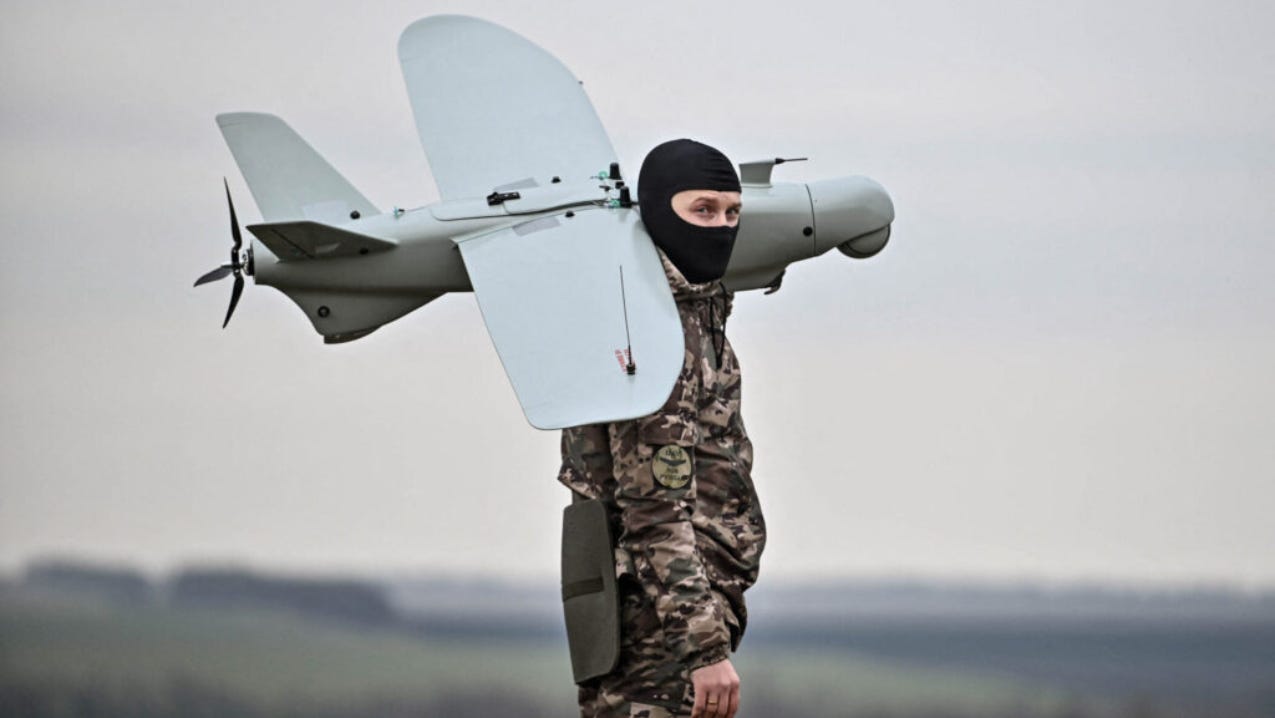
Ukraine will build nearly 7 million drones this year. It will have a lot of drones which are the equivalent of an artillery shell. You just send them off and don’t worry about it, because you can get another one. I was struck by this emerging autonomous warfare. It requires inexpensive weapons – the opposite of the exquisite, costly, and remarkably capable traditional American systems.
One lesson from the Ukrainian and Middle Eastern campaigns is that we must fundamentally rethink our approach to defense acquisitions. We cannot afford to fire a $2 million missile at a $70,000 drone. We can’t afford to build equipment that is too elegant and expensive to risk in combat.
While most of the attention to the emerging Ukrainian way of war focuses on drones, they are increasingly turning to ground-based robots. This new battlefield is too lethal to risk soldiers. Furthermore, as a much smaller country, Ukraine cannot afford the kind of casualties that Vladimir Putin’s dictatorship seems to accept. As a free country, Ukraine cares more for its citizens than Putin seems to care for his.
The result has been the development of a whole series of robotic vehicles that bring supplies to the front and serve as ambulances to take casualties out of combat.
The Russia-Ukraine War has now been going longer than World War I, yet the speed of evolution is amazing. I was told by experts analyzing the drone systems that Ukraine now develops new countermeasures to Russian vehicles in as little as 14 days. I doubt if the Pentagon could even write the request for bids in this time.
Congress and the Department of War need to take seriously the lessons of current realities in Ukraine, Iran, Lebanon, and elsewhere. There is a new, high tempo, low-cost style of war emerging which requires profoundly different organizations, doctrine, equipment, and training.
Prussian Gen. Moltke the Elder invented the general staff system in the mid-19th century in response to the development of the telegraph and the railroad. This common pattern of staffed, trained, orderly, and bureaucratic organization of war has been the dominant form since. It reached its apogee with the extraordinary organizational efforts of World War II.
This model, which still dominates and defines virtually every military in the world, is now being replaced by a different system in which real-time information flow, instantaneous access to battlefield data, and autonomous systems annihilate earlier models.
We do not really know how this is going to work out. We are only now seeing the glimmerings of a dramatically different future — with a much different cost structure and patterns of organization and leadership.
This will be a wrenching, controversial, and difficult challenge for the American military. We are the pre-eminent example of the power of Moltke’s organization. As we celebrated the memory of the Normandy Landing, there was a nostalgia for the solid systems and heroic men and women who defeated evil and liberated the continent of Europe.
However, at the same time, a new way of war is being invented in multiple conflicts across the planet.
Remember, we are not looking at the future. We are looking at the present that already exists in several conflicts.
It is time for the United States to move beyond World War II and invest in the emerging style of war.
Latest from Newt’s World:
You can manage your subscription preferences to choose the updates, newsletters, and alerts you want to receive on the website.


