


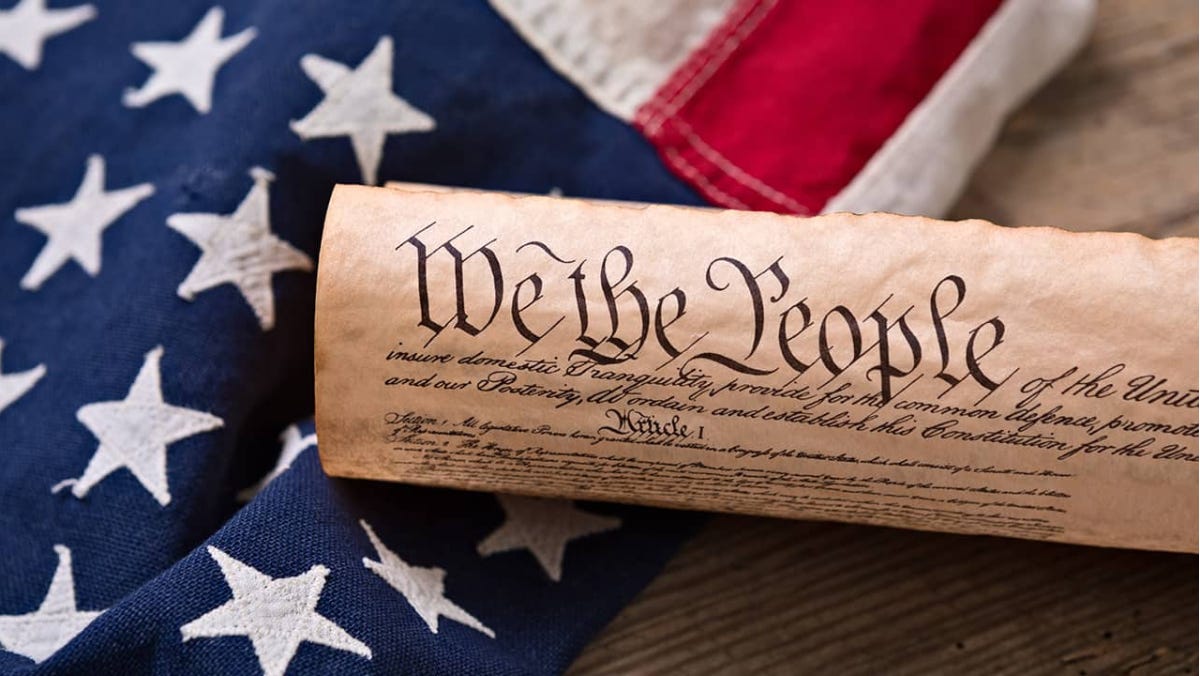
Every Sept. 17, our nation marks Constitution Day and Citizenship Day, a time set aside to reflect on the foundational framework of our democracy and the shared bonds of American citizenship.
Federal law mandates that every educational institution receiving federal funding conduct dedicated educational programming on the Constitution on this day. It is an annual reminder that forces us to look past the routine of daily life, ensuring that every rising generation understands both the mechanics and the moral weight of our self-governing republic. This day reminds us to examine the enduring covenant that binds us together across generations.
Recent national polling by America’s New Majority Project reinforces how deeply this shared legacy resonates: over 81 percent of Americans agree that all citizens should take pride in the founding fathers’ achievement in establishing the world’s longest-surviving democracy, while nearly 80 percent agree that they are proud to be an American.
My own deep appreciation for this date goes back to a classroom that brought these abstract ideas vividly to life. As a legal immigrant from Switzerland, I have been fortunate to be a product of American education and to absorb the values this country instills. Having spent my most formative years and all my adult life here in the United States, my perspective on this day is shaped by deep gratitude. On every Constitution Day, my high school AP Government teacher would dress up as prominent American historical figures and stride through the classroom, passing out pocket Constitutions to each student. His enthusiasm inspired me to learn about the Constitution, memorize its amendments by heart, and understand not only the rights it protects but also the responsibilities it demands. More importantly, he showed me that citizenship is not passive. It is something that must be practiced every day as an active commitment to participating in the ongoing story of American self-governance.
Consider the famous opening words of the Preamble:
“We the People of the United States, in Order to form a more perfect Union, establish Justice, insure domestic Tranquility, provide for the common defence, promote the general Welfare, and secure the Blessings of Liberty to ourselves and our Posterity.”
When we reflect on this passage, we are confronted with both a bold promise and a profound responsibility. I know that no country is perfect, but the United States is a nation defined by its continuous strive to better itself through the constant pursuit of happiness and a more perfect union. It all has flaws, but as the saying goes, the grass is ultimately greener wherever you water it.
The Constitution balances authority and safeguards human dignity through core structural principles: popular sovereignty, in which government power derives strictly from the consent of the governed; the rule of law, which guarantees that no leader or institution stands above the law; federalism and the separation of powers, which split authority to prevent tyranny; and the Bill of Rights, which secures our essential liberties against government overreach.
Yet, the true beauty of “We the People” lies in its recognition that a document on parchment cannot preserve a republic on its own. Theodore Roosevelt said it best in his 1910 address at the Sorbonne in Paris, France:
“With you here, and with us in my own home, in the long run, success or failure will be conditioned upon the way in which the average man, the average woman, does his or her duty, first in the ordinary, every-day affairs of life, and next in those great occasional crises which call for the heroic virtues. The average citizen must be a good citizen if our republics are to succeed. The stream will not permanently rise higher than the main source; and the main source of national power and national greatness is found in the average citizenship of the nation; therefore it behooves us to do our best to see that the standard of the average citizen is kept high; and the average cannot be kept high unless the standard of the leaders is very much higher than the average.”
United States citizenship is first and foremost a privilege, one that must be honored, respected, and lived with an intentional sense of duty toward the American people and this country. Whether one is fortunate enough to be born as a U.S. citizen or earn that title through naturalization, extraordinary rights, liberties, and freedoms are both inherited and embraced. But those rights exist in a delicate balance with civic obligations. Freedom without responsibility eventually falters, and liberty without community devolves into isolation.
We must also remember that the Constitution and the freedoms it secures are protected by generations of Americans who have answered a higher call to service. The men and women in uniform exemplify an extraordinary commitment to country, sacrifice, and civic duty. Their dedication reminds us that the preservation of our constitutional republic depends upon citizens willing to serve something greater than themselves. We owe them a debt of gratitude that can only be repaid by how we choose to live our daily lives and whether we make a positive impact on our communities.
The strength of the United States has never rested solely in its institutions or its founding documents. It rests in its people. As America’s New Majority Project polling also found, over 81 percent of Americans affirm that the founding principles of equality, self-governance, and fundamental rights are just as relevant today as ever. Every day, ordinary Americans become extraordinary citizens by volunteering, serving their communities, participating in civic life, standing up for what is right, and working to build a better future for those around them. Every time citizens cast an informed vote, show up for jury duty, participate in town halls, advocate for fairness, or simply extend a helping hand to a neighbor, they help fulfill the Constitution’s aspiration to create a more perfect Union.
I am profoundly grateful to the United States, its citizens, and its institutions for all the opportunities and privileges I have enjoyed. As someone actively working toward one day becoming a U.S. citizen, I am excited to return that level of gratitude by dedicating myself to the service and protection of this nation, its constitution, and its citizens.
On this Constitution and Citizenship Day, everyone should reflect on the enduring promise contained in the opening words of the American Constitution: “We the People.” These three words remind us that the Constitution is not merely a document of laws and institutions; it is a covenant among citizens, a shared commitment to liberty, justice, and the common good. The question before each of us is not only what the Constitution guarantees, but what it asks of us in return.
As we celebrate today, let us pause to ask ourselves: What does the Constitution mean to me? How am I participating in civic life? How am I contributing to my community, supporting my neighbors, and helping to strengthen this country? How am I exercising the freedoms and liberties guaranteed by the United States Constitution, while also fulfilling the duties and responsibilities that accompany them?
On this Constitution Day, let us celebrate not only the rights it guarantees, but also the shared responsibilities it requires. Let us recommit ourselves to the timeless work of ‘We the People’ by building, protecting, and strengthening the American experiment — for present and future generations of Americans, whether citizens by birth or by choice, and for all who dare to dream of one day earning that privilege.
— With gratitude for the journey and steadfast hope for the privilege of one day calling this nation officially my own.
Danielle Greminger

You can manage your subscription preferences to choose the updates, newsletters, and alerts you want to receive on the website.