
‘USA! USA!’ Reflecting on the Miracle
If you want an evening of patriotism, in which the good guys win, watch “Miracle.”
Callista and I were privileged to have great seats in the hockey stadium on Feb. 22 when the United States played Canada for the gold medal in the Winter Olympics. At the time, it did not occur to us that this was the 46th anniversary of the “Miracle on Ice” at Lake Placid, N.Y.
The American team was widely regarded as the distinct underdogs to the Canadians, who had been incredibly effective in the Winter Olympics. However, we were delighted as our team fought to a one-to-one tie at the end of the three periods. When the overtime period started, we were stunned - as was most of the crowd - when almost immediately the Americans scored and won. I will never forget the moment when the puck crossed the line into the Canadian goal.
Forty-six years earlier, the “Miracle on Ice” was actually the semifinal game - but everyone assumed whoever won would go on to win the gold (and that is exactly what happened). America went on to beat Finland for the gold.
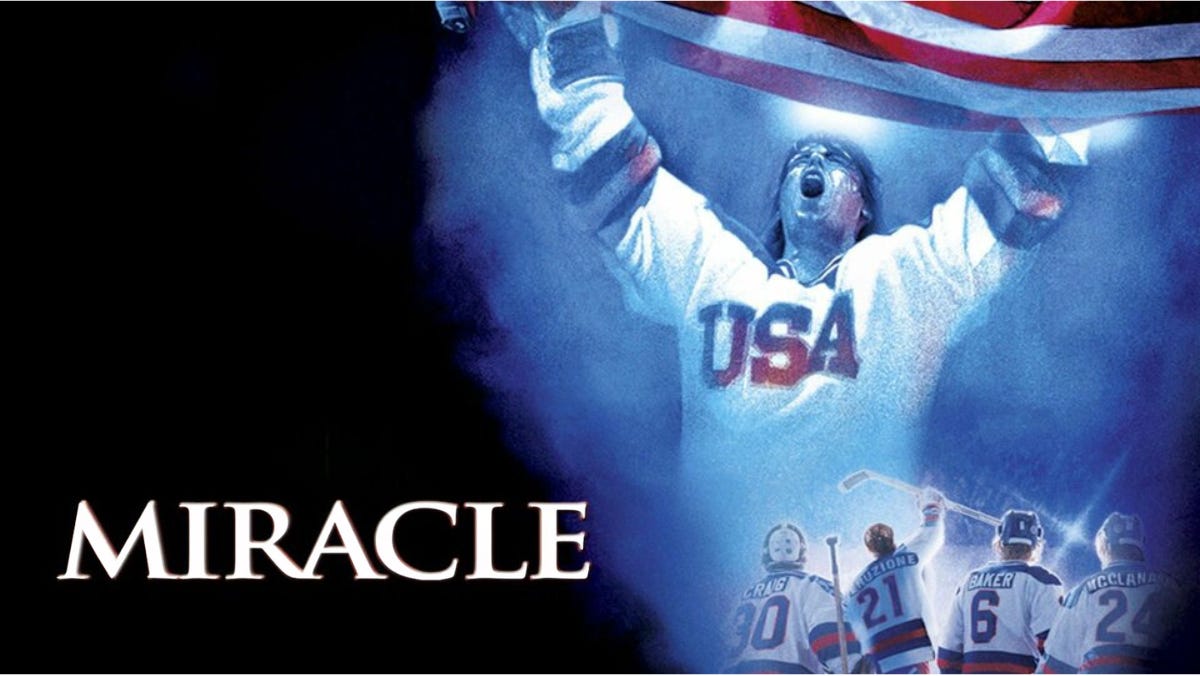
For the last week, we have been talking about these two games from 1980 and 2026. So, we decided to watch the 2004 movie “Miracle” with Kurt Russell. It was a fascinating movie, and members of the 1980 team have said it was largely accurate.
I entitled this newsletter USA! USA!, because this chant gave the young 1980 American team the energy to outlast the vastly superior Soviet team. (The USSR had skirted Olympic rules by installing professional hockey players at Russian universities so they could qualify. Meanwhile, the American team was the youngest team at the Olympics that year.)
In the movie, Russell plays Herb Brooks, University of Minnesota’s three-time national champion winning coach. Brooks explained how he thought he could beat the Soviets (who had won four straight gold medals in hockey in the Winter Olympics and were widely considered the best hockey team in the world).
Brooks favored younger, potentially less talented players who were willing to be a team over highly talented and experienced national hockey league players. He reasoned the professionals would play brilliantly as individuals but be unable to subordinate their egos to play as a team.
Brooks had a theory that the Soviets were simply in better shape than most of their competitors, and in the third period no one could keep up with them. He determined to push the Americans so they would have stronger legs and more stamina in the third period.
He was clearly driven by the need to win this game. He had tried out for the 1960 Olympics and been cut in the last week. He then found himself at home watching his teammates win the gold medal. That may have been a big factor in the intensity with which he pushed his team in training - and his own constant studying of game films of the Soviet team. He had to find whatever weaknesses they had.
Just before the game Brooks gave his young team a pep talk, which became famous after the victory - and was faithfully redelivered by Russell in the movie:
“Great moments are born from great opportunity. And that’s what you have here tonight, boys. That’s what you’ve earned here, tonight. One game. If we played ‘em ten times, they might win nine. But not this game. Not tonight. Tonight, we skate with ‘em. Tonight, we stay with ‘em, and we shut them down because we can! Tonight, we are the greatest hockey team in the world. You were born to be hockey players -- every one of ya. And you were meant to be here tonight. This is your time. Their time - is done. It’s over. I’m sick and tired of hearin’ about what a great hockey team the Soviets have. Screw ‘em! This is your time!! Now go out there and take it!”
They did go out and take it. By the third period, the American conditioning was clearly better than the Soviet’s. When they scored two goals, the Soviet coach was so rattled he pulled his goalie who was widely regarded as the best player in the world.
In both the 1980 and 2026 games, the American goalies played brilliantly and were decisive in keeping America in the game. In 1980, Jim Craig blocked 36 shots. This year, Connor Hellebuyck blocked an astounding 41 shots on goal - for which President Donald J. Trump awarded him the Presidential Medal of Freedom.
As the Americans closed in on winning in 1980, the announcer Al Michaels blurted out “do you believe in miracles?” As a sign of how big the upset in the “Miracle on Ice” was Sports Illustrated in 1999 called it the greatest achievement in 20th century sports.
If you want an evening of patriotism, in which the good guys win, and a compelling study of Brooks as played by Russell, I highly recommend watching “Miracle.”
It will remind you of why chanting “USA! USA!” is such a positive experience for Americans. When an entire hockey arena chants it, the adrenaline level of the players and audience skyrockets.
Callista and I are grateful for having experienced that personally in Milan. When we watched the movie later at home, we got to experience it again - and you can too.
Listen to the latest episode of Newt’s World:
You can manage your subscription preferences to choose the updates, newsletters, and alerts you want to receive on the website.


