

Venezuela: A Warning to Avoid the Quicksand
The lessons of history about the price of overconfidence leading to disaster are clear.
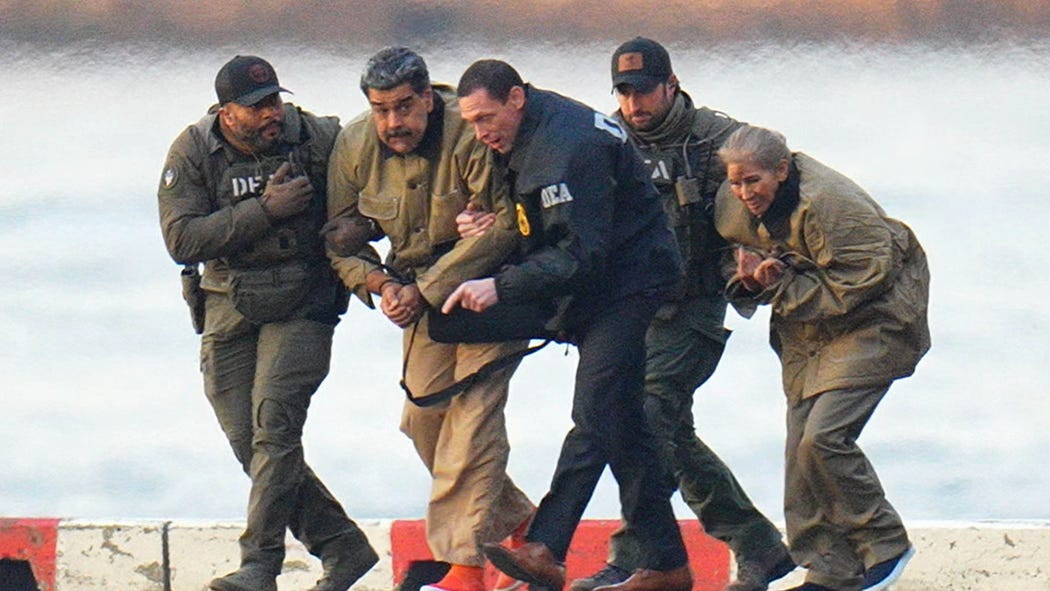
While watching President Donald J. Trump’s amazing briefing at Mar-a-Lago on the American capture and extradition of Venezuelan narco-terrorist Nicolás Maduro and his wife, I had two distinct emotions.
First, I felt great pride in the sheer technical ability of our military and the courage of President Trump. He acted decisively against a major drug trafficker who had corrupted his own country for years – and was deeply anti-American and allied with our most dangerous enemies.
Second, I had a deep concern about the next steps in Venezuela. Unless the Trump team is extremely careful, it is going to get mired down in a mess that will erode its political support and weaken its influence at home and abroad.
Phase one was brilliant. The United States clearly has the most advanced and powerful capacity for a single-targeted project of any country in history. We have proven that satellite intelligence and communications, massive air power, and joint forces are deeply effective. The doctrine of planning, training, planning, and retraining has clearly produced a system of incomparable lethality, accuracy, and reach. When the United States focuses its specialized forces and assets, it can achieve near-unbelievable things. Consider the capture of Manuel Noriega – to the elimination of Osama bin Ladin, Abu Bakr al-Baghdadi, and Qasem Soleimani – and now the capture of Maduro.
The danger for the Trump administration is that America’s extraordinary doctrine and system for specified one-time operations doesn’t translate to the long term. We have never run a foreign country or rebuilt a governing system with reasonable speed and expense.
Consider the lessons of Vietnam, Haiti, Iraq, and Afghanistan. In each case, we sent in our extraordinarily powerful military, and it established absolute short-term dominance. But we were unable to then create a deep cultural-political-economic dominance necessary for practical (and perceived) victory.
The only exception to this was the 1989 liberation of Panama. Panamanian dictator Noriega’s indictment as a drug dealer is a reasonable precedent for the Trump administration use (although, embarrassingly, Noriega had been paid by the Central Intelligence Agency and the drug cartels). However, Panama was a relatively small and healthy country at the time. Guillermo Endara had won the presidential election and been blocked from power by Noriega. He was sworn in immediately after the Americans took over. Returning Panama to the control of Panamanians took less than a month.
Venezuela is going to be far more difficult and dangerous. First, Panama has about 4.6 million people, most of whom live in cities. Venezuela has 28.5 million people – more than six times Panama’s population. Furthermore, Venezuela is geographically large. It is 340,000 square miles, about one-third bigger than Texas.
Hugo Chávez took over on Feb. 2, 1999. The dictatorship he established was continued by Maduro. It has driven much of the middle class out of Venezuela. This produced criminal elements and enormous local violence. These corrupt systems now define much of daily life for Venezuelans.
The gang members and government supporters who have profited from this narcotics-funded system of criminality are not going to suddenly turn into angels now that Maduro is gone.
There is an enormous structure of power which will fight to survive. The senior leaders will take President Trump’s threats seriously. However, they will also rely on their Socialist ideological commitment – and the exploitation of Venezuelans and others through violence, criminality, human trafficking, and drug dealing. They will also remain willing to kill to keep power.
There is a grave danger that the United States will gradually be drawn into using its own troops and capabilities against the open criminality that will still exist. Venezuela is post-Maduro. But it is not post corrupt gang domination.
The key question for President Trump and his team will be whether they have the patience to find ways to help Venezuelans govern Venezuelans -- rather than use American forces. The latter would be a disaster – and turn into another forever war. We would be mired down in a long, drawn out policing operation. This would rapidly become unacceptable to the American people.
The liberal elites will want the Trump administration to impose a new order on Venezuela. At the same time, they will be prepared to attack President Trump if any Americans are killed trying to reform Venezuela. The heart of the Make America Great Again movement will support a lightning strike by our military to seize Maduro – but it will deeply oppose sending young Americans to police a criminal-run country larger than Texas.
President Trump should encourage the growth of a post-Maduro, better Venezuela. But he should avoid sending any American troops in to try to force that reality.
An alliance could be formed with the least corrupt elements of the Venezuelan system (note I did not suggest honest or desirable). Then, it might be plausible in some circumstances to use American airpower to tilt the balance of power for the less corrupt to effectively drive out the more corrupt. We have developed systems of targeted attack in the Middle East which could be used in Venezuela with almost no risk. They could be decisive in ensuring a pro-American faction ended up dominating the country.
Finally, working out American interests in Venezuelan oil could be a major advantage for the people of Venezuela. It has been amazing to watch the country with the largest reserves in the world methodically mismanage its oil fields. It has kept its own people impoverished while sitting on tens of billions in developable oil.
However, any oil agreements must be obviously advantageous for the Venezuelan people. They must feel they are winning – and that they will be much better off economically because Maduro has been replaced with a government which can actually develop the country.
To the degree the new giant oil companies need protection on the ground, it should ideally be provided by the pro-development faction of the government. This should be part of funding the more reasonable people and crowding out the corrupt and criminal elements. In a worst case, the oil companies should be required to hire private security to protect their operations. Under no circumstance should American government forces be engaged in policing inside Venezuela.
Act one was brilliant.
Act two will be much more complicated. It should be approached with extreme caution by President Trump and his team. The lessons of history about the price of overconfidence leading to disaster are clear. These lessons should be top of mind for President Trump and his team.

Listen to the latest episode of Newt’s World:
Catch up on Founding Fathers Week on “Newt’s World!” Discover the fascinating stories of America’s revolutionary leaders and ignite your patriotism like never before!
You can manage your subscription preferences to choose the updates, newsletters, and alerts you want to receive on the website.
Thank you so much, Mr. Speaker, for the clarity and specificity of your thoughts about a post-Maduro Venezuela and the next steps for President Trump & his administration. I'm praying for all of them to heed your warnings and follow your advice.