


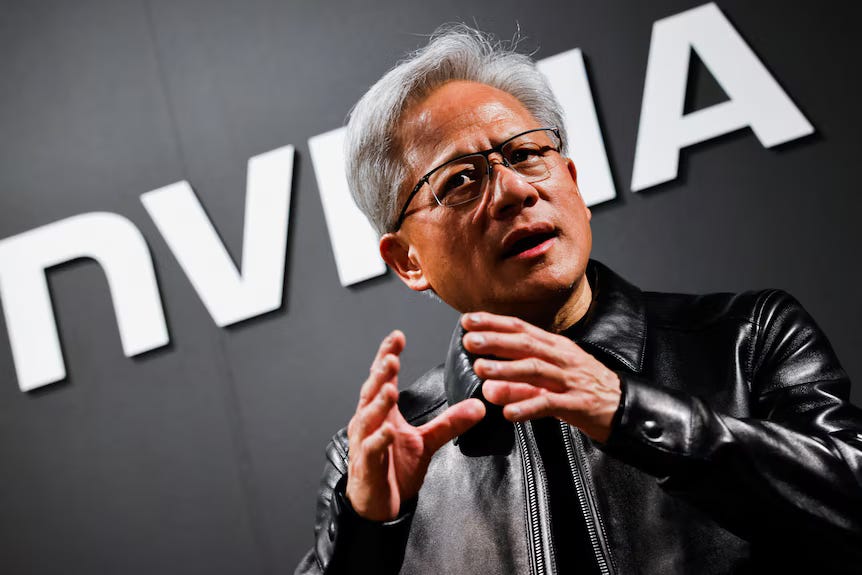
Newt Gingrich and former National Security Council Chief of Staff Fred Fleitz examine China's expanding intelligence operations and the threats to American technology, business, and national security.
China's intelligence operations extend far beyond traditional espionage. From Silicon Valley boardrooms and advanced artificial intelligence technology to American universities, military installations, and critical infrastructure, Beijing has developed an increasingly sophisticated network for acquiring information and gaining influence. As new allegations involving Nvidia CEO Jensen Huang raise questions about Chinese intelligence recruitment tactics, the broader challenge facing the United States is becoming harder to ignore.

In this episode of Newt's World, former Speaker of the House Newt Gingrich welcomes Fred Fleitz, a veteran intelligence official and former National Security Council Chief of Staff, to examine the scale of China's espionage activities and America's ability to respond. Drawing on his 25 years of national security experience, Fleitz explains how Chinese intelligence operations differ from those of the Soviet Union, why American corporations remain vulnerable, and how Beijing targets everything from military technology to academic research. Their conversation explores the growing intersection of economic competition, technological innovation, and national security — and what the United States must do to protect its most valuable assets.
Listen to their conversation below, or scroll down for an edited transcript.
Edited Transcript
This conversation has been condensed and lightly edited for clarity.
Newt Gingrich
Welcome to Newt’s World. Over the weekend, Nvidia, the company making the chips powering the artificial intelligence revolution, announced that its board was investigating CEO Jensen Huang following reports of a relationship with a Chinese businesswoman whom U.S. officials reportedly believe was recruited by China’s intelligence service.
This is far from the only case raising concerns about Chinese espionage. We’ve seen attempts to recruit American sailors, surveillance of people connected to Taiwan, and Chinese cyber operations targeting America’s communications networks and critical infrastructure.
How big is China’s spy network inside the United States, and are we doing enough to stop it?
My guest is Fred Fleitz, vice chair of the Center for American Security at the America First Policy Institute and former chief of staff of the National Security Council. Fred spent 25 years in national security positions with the CIA, Defense Intelligence Agency, State Department, and House Intelligence Committee.
Fred, welcome back to Newt’s World.
Fred Fleitz
Good to be here.
Newt Gingrich
Let’s start with the Nvidia investigation. When you heard the reports about Jensen Huang and his relationship with a Chinese businesswoman suspected of having ties to China’s Ministry of State Security, what was your reaction?
Fred Fleitz
I think a lot of Americans are wondering how this keeps happening.
Private industry underestimates the threat from China and often doesn’t take adequate steps to defend itself. Companies have already suffered significant cyber thefts, but they still don’t fully appreciate the determination of the Chinese Communist Party to manipulate our free system and steal trade and military secrets.
China’s intelligence operations are far more sophisticated than people think.
In this case, the woman reportedly headed a cloud computing company in Singapore that was doing substantial business involving Nvidia chips. According to the allegations, the company was helping Chinese customers obtain access to technology despite American restrictions.
This wasn’t simply someone approaching an executive at a bar. There was a substantial commercial relationship involved.
Newt Gingrich
Didn’t we deal with this kind of intelligence operation throughout the Cold War with the Soviets?
Fred Fleitz
Intelligence services have used these techniques for a very long time. The Russians used them successfully during the Cold War.
What’s different today is that Chinese intelligence is much more sophisticated and has a much larger operation than the Soviet Union did.
The Soviet economy limited its ability to penetrate Western industries. China has enormous corporations involved in advanced technology, cybersecurity, and international commerce.
That gives Chinese intelligence opportunities to infiltrate American society, businesses, and the military much more effectively than the Soviets could.
Newt Gingrich
Part of what made this particular relationship unusual was that the woman reportedly came with very large purchase orders. She wasn’t just developing a personal relationship. She was also a major customer.
Fred Fleitz
That’s right.
Another important distinction is that China doesn’t always rely on people who began their careers as trained intelligence officers.
Chinese intelligence can recruit civilians later, when an opportunity presents itself. Because these individuals may have legitimate business careers and no obvious intelligence background, they’re much harder for the United States to detect.
Newt Gingrich
What was the ultimate danger of the relationship?
Fred Fleitz
I think it was enormously dangerous because the United States has to win the competition over artificial intelligence.
The concern is that this relationship may have been used to influence decisions about restrictions on advanced Nvidia chips and facilitate access to technology that China otherwise couldn’t obtain.
If those allegations are accurate, the potential damage to American national security is significant.
Newt Gingrich
These chips are essential to advanced computing. Without highly sophisticated chips, much of this technology simply doesn’t work. Is that a fair summary?
Fred Fleitz
Yes. Artificial intelligence requires enormous computing power, extremely fast computers, and very expensive chips.
Nvidia makes some of the best chips on the market and continues developing new designs.
China has struggled to produce comparable technology domestically. And we’ve seen in the past that when China cannot develop certain technologies itself, it tries to acquire them elsewhere.
Newt Gingrich
That also makes Taiwan extremely important.
Fred Fleitz
That’s right. Many of these advanced chips are manufactured in Taiwan.
And the Singapore company discussed in these reports isn’t the only business suspected of helping China circumvent American restrictions. Other companies have also come under investigation.
Newt Gingrich
On a parallel front, there’s the case of Christine Fang, known as Fang Fang, who developed a relationship with Congressman Eric Swalwell.
What does Chinese intelligence hope to gain through those kinds of relationships?
Fred Fleitz
That case illustrates the challenge we’re facing.
Fang developed connections with Swalwell before he entered Congress. When someone has access to a member of Congress and information about their schedule, they can potentially learn an enormous amount about meetings, contacts, and activities.
Even without access to classified documents, information about whom an official meets and where that official travels can be valuable to a foreign intelligence service.
I also believe the political response to that case raised serious questions about how national security concerns are handled.
Newt Gingrich
Nancy Pelosi had historically been very tough on the Chinese Communist government, particularly over Tiananmen Square. Why do you think the response was different in this situation?
Fred Fleitz
My concern is that political considerations can sometimes take precedence over national security.
Sensitive intelligence positions require a very high standard of judgment. When serious counterintelligence concerns arise, I believe protecting the country has to come before political interests.
Newt Gingrich
Returning to Nvidia, there were reports that Secretary of State Marco Rubio had already raised concerns about the situation.
Fred Fleitz
There are difficult questions about what the government knew and when it knew it.
According to the reports we’re discussing, Nvidia was conducting an internal investigation, and U.S. intelligence and Justice Department officials had identified concerns.
I think the Trump administration needs a thorough internal review to determine who knew what, when they knew it, and whether appropriate action was taken.
The question is how much potential damage may have occurred between the initial warnings and the eventual response.
Newt Gingrich
Do you think Huang’s influence has diminished significantly as a result?
Fred Fleitz
I think his reputation has suffered.
Nvidia is an enormous company, and I believe it will continue to be successful. But Huang founded the company and has been central to its direction.
He owes explanations to his board, investors, and the American public about what happened.
Newt Gingrich
Why is Nvidia such an important company in the first place?
Fred Fleitz
Nvidia originally developed chips for video displays and computer graphics.
Huang recognized that this technology could also be used for high-speed artificial intelligence processing. That gave Nvidia an important technological advantage.
The company continued building on that advantage and became a leader in the advanced chips essential to AI.
Newt Gingrich
So he was a technological pioneer and, in that sense, a very high-value target for Chinese intelligence.
Fred Fleitz
Absolutely. He was a very high-value executive.
The U.S. government and corporate leadership should recognize that executives involved in strategically important technologies are potential intelligence targets.
That’s one of the larger lessons from this situation.
Newt Gingrich
How would you compare China’s investment in intelligence with the effort the Soviet Union made?
Fred Fleitz
There’s really no comparison, largely because China is so much wealthier than the Soviet Union ever was.
China reportedly has enormous numbers of personnel involved in cyber warfare and intelligence operations.
The Soviets focused heavily on compromising Western officials and obtaining political and military intelligence. China does that too, but it places much greater emphasis on economic espionage.
And I believe the Chinese are much more effective at it than the Soviets ever were.
Newt Gingrich
The New York Times has discussed estimates of hundreds of thousands of Chinese intelligence agents. Is that plausible?
Fred Fleitz
I think it is.
China is particularly effective at infiltrating Western society because it can operate through commercial relationships, educational institutions, and other legitimate channels.
One of the challenges is that many Americans don’t recognize the scale of the threat.
Newt Gingrich
Do we need more proactive rules to minimize China’s ability to penetrate the United States?
Fred Fleitz
We have to do much more to defend our country against Chinese intelligence.
For years, the government has tried to warn private industry about Chinese hackers and espionage, yet some companies still haven’t established adequate defenses.
We need to communicate directly with executives at major corporations and defense contractors so they understand the risks.
What we’re discussing in connection with Nvidia illustrates vulnerabilities that could exist at other companies.
Newt Gingrich
How much of China’s intelligence effort is directed at penetrating our military, and how much is directed at stealing our technology?
Fred Fleitz
There’s no doubt China is trying to do both.
It wants to acquire military technologies it cannot develop independently and understand American military innovations.
Stealth technology is one example. Even if China obtains information about American stealth aircraft, it may not have the manufacturing capabilities to duplicate them.
But that information could still help China identify vulnerabilities and develop ways to counter American aircraft.
I suspect military intelligence is the priority, although economic espionage is also a major focus.
Newt Gingrich
We’ve also seen reports about Chinese Communist authorities operating unofficial police stations in American cities, including New York.
How does that work, and why do we tolerate it?
Fred Fleitz
There have been instances involving offices or other locations allegedly operated by individuals connected to Chinese security services.
These operations can be used to pressure members of the Chinese diaspora, including American citizens and permanent residents, to support the objectives of the Chinese Communist Party or refrain from criticizing it.
That’s an especially troubling form of foreign interference.
There has been bipartisan concern in Congress about these activities, and it’s an important issue for the FBI to address.
Newt Gingrich
There was also a report earlier this year about more than 10,000 Chinese scholars at American universities and laboratories.
That’s a breathtaking number.
Fred Fleitz
We frequently discuss the need to prevent intellectual property theft involving academic institutions, but efforts to address the problem often encounter resistance.
Universities benefit financially and academically from international students and researchers.
At the same time, some research involves highly sensitive fields, including engineering, nuclear science, and technologies with military applications.
The challenge is protecting important research without ignoring the benefits of legitimate academic exchange.
Getting universities to cooperate with stronger counterintelligence measures has been very difficult.
Newt Gingrich
What did you make of the Chinese surveillance balloon that crossed the United States?
Fred Fleitz
I saw it as a very bold Chinese intelligence operation.
The balloon carried surveillance equipment and traveled across the country, including near sensitive military locations, before it was shot down over the Atlantic Ocean.
I believe China was testing how the United States would respond.
The incident demonstrated both the willingness of Chinese intelligence to take risks and the importance of having a clear national security response.
Newt Gingrich
It certainly wasn’t a small balloon. It was a major incident.
Fred Fleitz
There’s another concern involving American students studying in China.
President Xi has discussed welcoming large numbers of American students to Chinese universities.
Educational exchanges can be valuable, but there have been cases in which American students were targeted for intelligence recruitment while abroad.
I remember a case involving an American graduate student who was recruited and paid to pursue a U.S. government position that could provide access to classified information.
That illustrates why students need to understand the potential risks before traveling to countries where foreign intelligence services may target them.
Newt Gingrich
If you were back at the National Security Council, what are the first three things you would do to shut down China’s spy network?
Fred Fleitz
First, I would make a major effort to ensure corporations and the military fully understand the Chinese Communist Party’s intelligence threat.
We’re not doing enough to educate people about these risks.
Second, I would strengthen enforcement of rules prohibiting cell phones and other electronic devices in classified areas.
Electronic devices can create serious security vulnerabilities, and there should be no tolerance for violating those rules.
Third, I would examine what the U.S. government is doing through its own intelligence operations to counter the Chinese Communist Party and Chinese companies involved in these activities.
Some of that work may already be underway, but I would push to make our counterintelligence efforts as effective as possible.
Newt Gingrich
Fred, thank you for joining me again on Newt’s World.
Your perspective has been very helpful, and this conversation could not be more timely.
Listeners can find Fred’s work at americafirstpolicy.com. His latest book is An America First Approach to U.S. National Security.
Fred Fleitz
Good to be here.
About the Guest
Fred Fleitz is vice chair of the Center for American Security at the America First Policy Institute and a former chief of staff of the National Security Council under President Donald Trump. He has more than 25 years of national security experience, including positions with the CIA, Defense Intelligence Agency, State Department, and House Intelligence Committee. He is the author or editor of seven books, including An America First Approach to U.S. National Security.

You can manage your subscription preferences to choose the updates, newsletters, and alerts you want to receive on the website.