
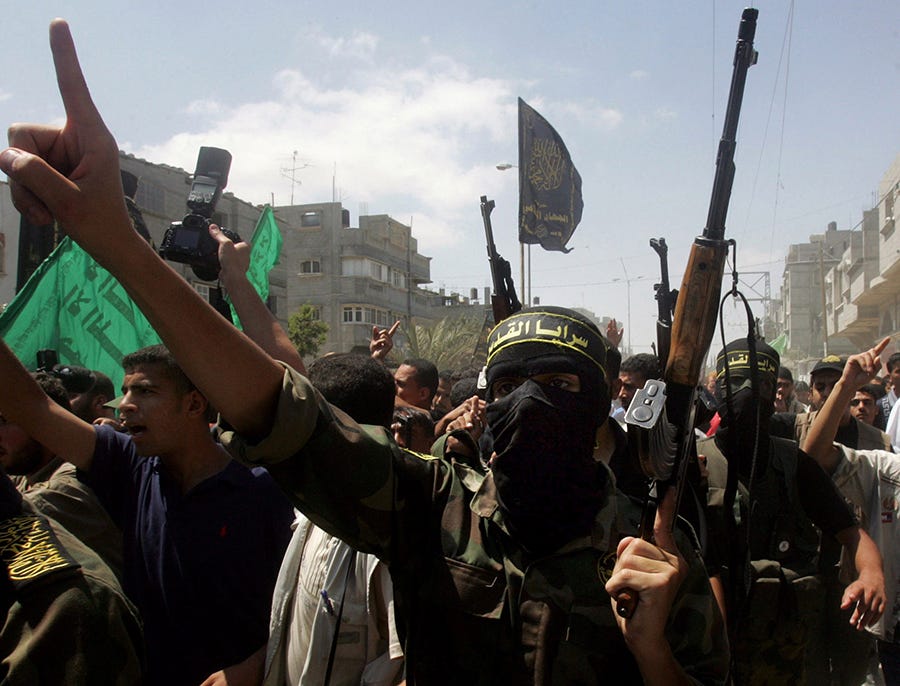
Deradicalization is the Key to Peace in Gaza
These are the kind of practical, doable steps which could really make President Trump’s vision of a peaceful, prosperous, safe Gaza become reality.
President Donald J. Trump’s remarkable effort to bring peace to the Middle East goes all the way back to his speech to the America Israel Public Affairs Committee on March 22, 2016.
Then-candidate Trump said:
“In Palestinian society, the heroes are those who murder Jews. We can’t let this continue. We can’t let this happen any longer.
“You cannot achieve peace if terrorists are treated as martyrs. Glorifying terrorists is a tremendous barrier to peace. It is a horrible, horrible way to think. It’s a barrier that can’t be broken. That will end and it’ll end soon, believe me.
“In Palestinian textbooks and mosques, you’ve got a culture of hatred that has been fomenting there for years. And if we want to achieve peace, they’ve got to go out and they’ve got to start this educational process. They have to end education of hatred. They have to end it and now.”
With this direct, bold, and unequivocal commitment to deradicalizing Palestinian society, President Trump put the focus where it should be.
Now in 2025, the Trump peace plan’s first point is “Gaza will be a deradicalized terror-free zone that does not pose a threat to its neighbors.”
Deradicalization is the key to driving Hamas out of Gaza. If large parts of Gaza’s population support Hamas, it will remain a serious threat. As Mao Zedong wrote in his classic work “On Guerrilla Warfare” from 1937, “the guerrilla must move amongst the people as a fish swims in the sea.” Simply put: In Gaza today, there are far too many “fish” willing to help Hamas evade detection, move weapons, and train terrorists. When 40 percent or more of a population favors terrorists, it is almost impossible to create a stable, peaceful environment conducive to coexistence.
The first real focus of the Trump plan must be on methodically eliminating all the components which encourage radical action and replacing them with deradicalization programs which have been effective in other countries.
For example, the Saudi Arabia of Sept. 11, 2001, looks nothing like the kingdom whose Crown Prince visited the White House this week. Saudi-funded mosques, imams, and religious schools no longer preach jihad. Economic and social reforms have provided new opportunities for people. The kingdom offers extensive counseling and benefits to extremists participating in its reform program, including marriage support and employment assistance. The program emphasizes family involvement in the rehabilitation process.
In the wake of a series of bombings in Casablanca in 2003, Morocco implemented a counterterrorism strategy combining aggressive security operations with socioeconomic development and religious education oversight. Morocco established a new training program for imams that promoted moderate interpretations of Islam, reformed religious education curricula, and created a reconciliation program for rehabilitating extremist prisoners.
The United Arab Emirates has long been a leader in the Islamic world for promoting deradicalization. The UAE’s National Program for Religious Moderation, encourages tolerant Islamic values and respect for foreign culture by designing curricula for imams and preachers, among others.
At the foundation of the Abraham Accords is the belief that coexistence, cooperation, and economic integration are better than violence, hatred, and isolation. This same spirit must be instilled in the Palestinian population.
This is why the Trump plan charges the local Palestinian governance body with delivering public services that preach peace and coexistence. Palestinian leaders must lead by example and demonstrate that the path to prosperity lies through coexistence and not violence. Any Palestinian leader involved in the new body and Gaza reconstruction must commit to these principles prior to joining – and must be dismissed if they subsequently fail to live up to this standard.
The Trump plan also calls for new schools established in Gaza to teach curriculum focusing on peace and coexistence – but not ignoring Palestinian history. Existing textbooks and curricula provided by the Palestinian Authority and the United Nations Relief and Works Agency for Palestine Refugees must be eliminated. They are rife with anti-Israel, anti-America, and antisemitic content. For example, current curriculum teaches sixth graders in Gaza that “The Zionists are the terrorists of the modern age and they are fated to disappear.” It asks 10th graders to explain “Why do the Jews perpetrate massacres?” Other questions and lessons reference the benefits of Palestinian martyrdom for Allah. Educators will need to be retrained, vetted, and monitored to ensure they don’t continue to indoctrinate children with hate.
As an immediate and interim measure, the Institute for Monitoring Peace and Cultural Tolerance in School Education can provide an appropriate curriculum and textbooks. It has a long history of working in the region to analyze textbooks, mitigate extremist influences, and moderate ideological prejudice. In the longer term, a new and better curriculum tailored to Gaza’s specific needs must be created. Of course, for deradicalization to be effective, it must be supported by a community approach that involves parents and families reinforcing the lessons taught in school.
Similarly, religious teachers and imams must be closely observed and counselled to ensure they are not spreading radicalism. As I mentioned, other majority Muslim countries have extensive experience in reforming religious education, training imams, and ensuring mosques are not used to preach extremism. President Trump should ask allied nations to take a leadership role in these areas. The Emirates have already expressed an openness to taking on a role in this area. Importantly, nations that support the radical ideology of the Muslim Brotherhood must have no role in the educational and religious future of Gaza.
Pro-Hamas government-controlled media outlets – including Al Jazeera and other anti-Israel and anti-America government propaganda vehicles – have fanned radicalization, parroted Hamas narratives, spread fake news stories, and portrayed President Trump and Israel as hostile actors. Deradicalization requires These propaganda outlets to be closed. The President should insist that Qatar force Al-Jazeera, which is owned by the royal family, to cease inaccurate, inflammatory, and hate-filled media narratives. The relentless parade of anti-Israel extremists featured on Al-Jazeera must end. Similarly, social media companies should be encouraged to block radical content that normalizes violence and promotes Hamas’s ideological extremism.
Finally, The UNRWA should be disbanded altogether. The Trump plan, and any deradicalization effort, will fail if UNRWA still exists. The reason for the non-governmental agency’s 76-year existence is to radicalize people and maintain its own existence through the perpetuation of victimhood and false promises for an impossible future. President Trump should prohibit the Board of Peace from working with the agency and ensure it has no role in humanitarian aid and reconstruction efforts in Gaza – or anywhere. The mandate of UNRWA was recently renewed for another year by the U.N. General Assembly. It will continue to be renewed unless the White House uses all available tools to force its wind down (in all areas, not just Gaza).
The agency should be designated a terrorist organization given its long demonstrated track record of infiltration by Hamas and provision of material support to the terror group. President Trump’s plan should permanently bar American funding for UNRWA and reduce US funding to the UN by the full amount of the UNRWA’s budget for as long as the agency exists. President Trump’s plan should also call for legislation to revoke UNRWA’s diplomatic immunity in the United States.
These are the kind of practical, doable steps which could really make President Trump’s vision of a peaceful, prosperous, safe Gaza become reality.
Listen to the latest episode of Newt’s World:
You can manage your subscription preferences to choose the updates, newsletters, and alerts you want to receive on the website.


