
Ever-Changing History
When people tell you something is a fact, you should ask them why are they so certain.
I am reading Stephen Brusatte’s remarkable “Rise and Reign of the Mammals: A New History from The Shadow of the Dinosaurs to Us.” It is a remarkable book because Brusatte is a delightful writer and storyteller.
We are living in the greatest period of paleontology discoveries in history. The development of new technologies has enabled us to understand events and animals in a way that was literally impossible even 50 years ago. Furthermore, there are more paleontologists in more countries, and the sheer opportunity for collecting has expanded widely.
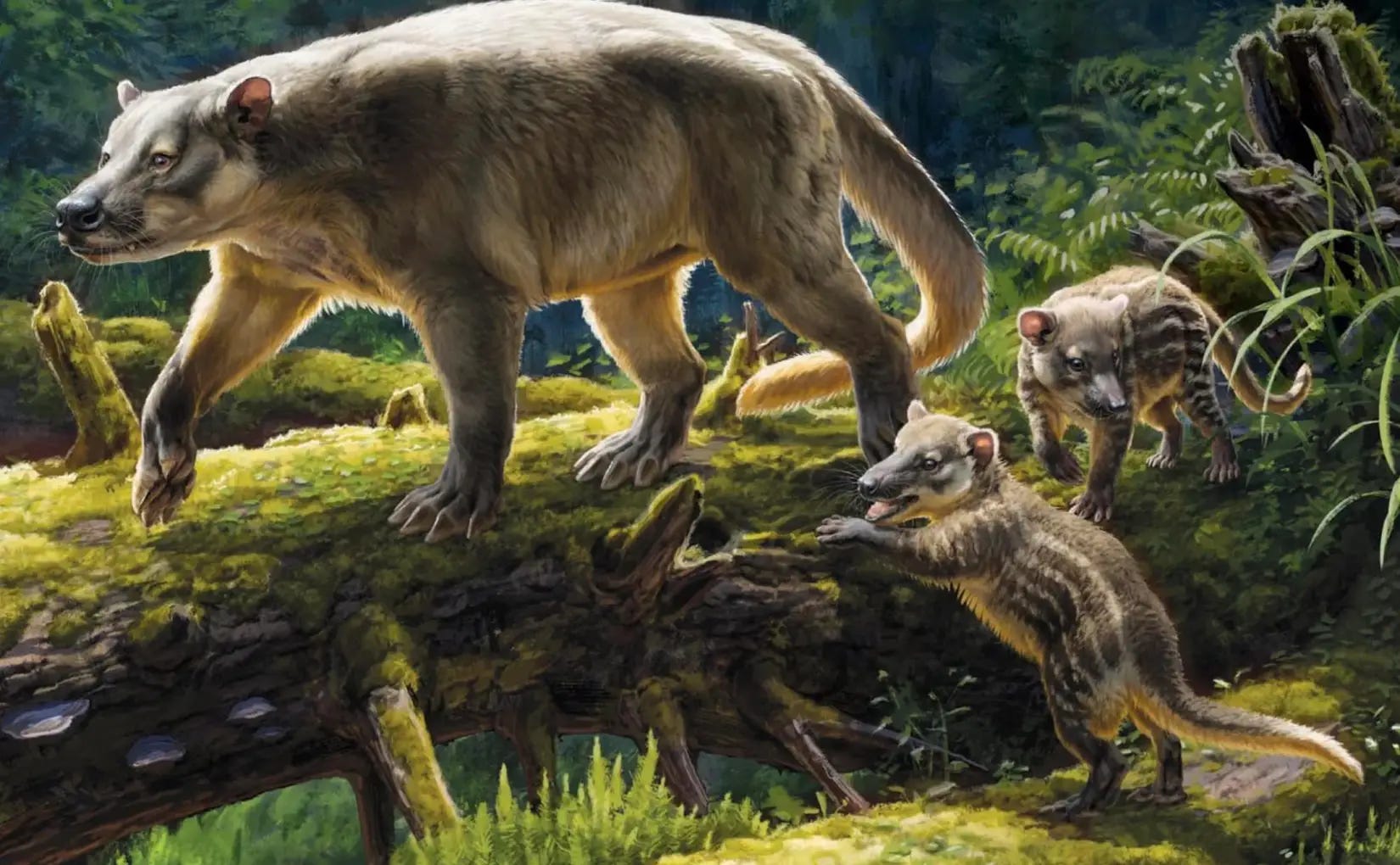
Traditionally, we thought dinosaurs were totally dominant, and mammals were tiny creatures hiding in burrows and skulking about to avoid being eaten by their giant neighbors.
As Brusatte points out, we are now discovering many different mammal species that flourished during the age of dinosaurs which we never knew existed. So, we really must rethink our entire mindset about that ancient ecosystem. He argues that mammals dominated at night, and in confined places, while dinosaurs dominated during the day and in open spaces.
When Brusatte made the argument that mammals developed as small creatures because they out-competed small dinosaurs, he forced me to profoundly rethink my entire image of the Triassic, Jurassic, and Cretaceous periods. Brusatte said that it was really a dual era of dominance. Dinosaurs reigned in the big world, while mammals dominated the small one. In effect each group had become dominant in its share of the world. He asserted that the diversity of mammal species—and the wide range of their habitats—meant the age of the dinosaurs could be considered as much as the first age of mammals. When the Earth’s climate was transformed after being struck by a 10-to-15-kilometer asteroid, the giant dinosaurs went extinct because they were so big. They simply could not find enough food or shelter during the worldwide catastrophe caused by the impact. Mammals and birds (which were also dinosaurs) could hide long enough to survive and re-emerge into the world as the climate stabilized.
In Brusatte’s telling, you could make a pretty good argument that we now live in the second age of mammals.
What really hit me was how this shift in focus from dinosaur dominance to shared dominance was such a dramatic break from the history I had always known—and that new discoveries constantly change history.
When I was young, dinosaurs were all portrayed as being reptilian (this was a 20th century adaptation, because in the 19th century they were portrayed with more warm-blooded characteristics). When I was in graduate school in 1969, paleontologist John Ostrom provided solid evidence that birds were in fact dinosaurs—and so dinosaurs had not fully gone extinct. Interestingly, Thomas Huxley had proposed in the late 1860s that birds were descended from small carnivorous dinosaurs—but that argument was rejected for a century until Ostrom revived it with new knowledge and new fossils.
I was reminded of the ways in which science evolves and changes when I encountered Robert Bakker’s 1986 book “The Dinosaur Heresies: New Theories Unlocking the Mystery of the Dinosaurs and Their Extinction.” Bakker brilliantly reminded us that science is often wrong and must change as new evidence and information becomes available.
Bakker was important in my own evolution of thinking about facts and evidence. New facts often lead to new hypotheses. These new hypotheses lead us to look in new directions to find new data to either reinforce or undermine the latest theory.
In short, when people tell you something is a fact, you should ask them why are they so certain.
Everyone knew that the continents were stable until Alfred Wegener’s 1915 proposal that the continents were drifting. This was rejected by the scientific community until the 1960s when the evidence became overwhelming that the continents were floating on tectonic plates that migrate over time.
Several of the most famous physicists of his day rejected Albert Einstein’s theory of relativity until the proof eventually became overwhelming.
It is useful to remind ourselves that knowledge is constantly changing—and that we will almost certainly have breakthroughs in the future that overturn what we currently know. Especially at this point in time—when so many new discoveries are being made—we must be much more skeptical and flexible to adapt.
We must make the choice between being the big, dead dinosaurs, or the small, resourceful mammals.
Listen to the latest episode of Newt’s World:
You can manage your subscription preferences to choose the updates, newsletters, and alerts you want to receive on the website.


I just finished Dan Brown’s latest novel, “The Secret of Secrets,” which is an exploration of consciousness, the biggest secret that ever faced mankind— “what happens after we die?” The science throughout the book is presented in his usual fast-paced thriller way, but I could not help but compare it to your theory that as man progresses so does allegedly “settled” science. The world is not flat, the solar system does not revolve around the earth, and knowledge is not a static thing. And we have our faith in something greater than ourselves to thank for man’s incessant curiosity. The older I get and more I see, the more I believe in God, and less in mankind with all our limitations.