
Making Work Great Again
According to Eberstadt, among unemployed men, there are three who are not looking for work for every one trying to find a job.
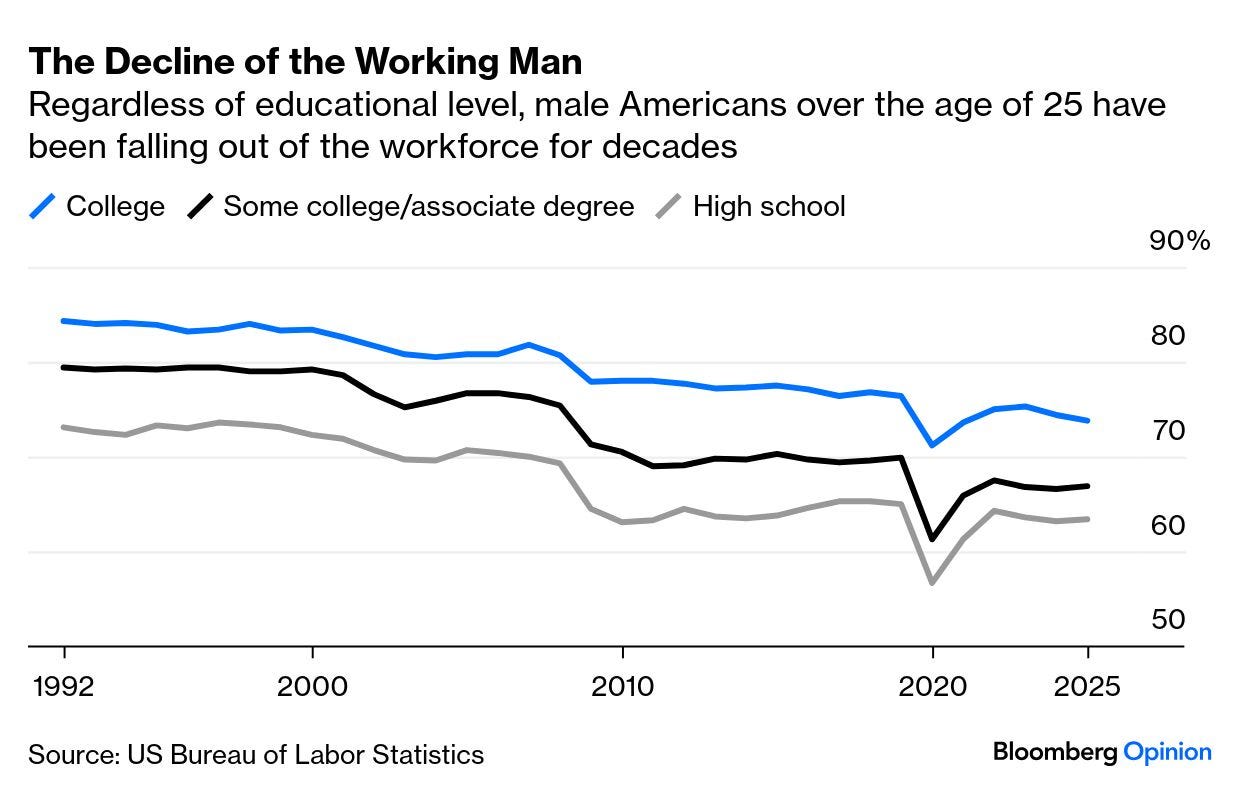
As Nicholas Eberstadt wrote last week in the Washington Post, there are 7 million American men between 25 and 54 who are not working—or even trying to find a job.
While it has been true for years, this is a radical change at the core of American culture and society.
Historically, work has been central to the American experience. People who migrated to America expected to work. Thanksgiving emerged among the pilgrims after a year of hard work. The wagon trains which carried American civilization west required a lot of work. The great American arsenal of democracy flooded the world with the weapons to defeat Nazi Germany and Imperial Japan—thanks to the work of millions of Americans.
President Ronald Reagan often said “work is the best social program.”
As Marvin Olasky wrote in his 1992 book “The Tragedy of American Compassion,” President Lyndon Johnson and his Great Society broke the connection between work and fulfillment. As Olasky described, the traditional reformers all believed in tough love for the poor. They envisioned a system in which people were expected to work—and show discipline and restraint with alcohol, drugs, and indolence.
The new generation of left-wing welfare reformers of the Great Society believed in collective behavior in which individuals should not be held accountable for their actions (or inaction). They did not want to pressure people into working who did not feel like it. They preferred supposedly compassionate dependence to tough love with work and independence.
There was also a huge surge toward recognizing disabilities even if they did not exist. People were increasingly encouraged to allow themselves to be passive and dependent on others. Instead of examining people to see what they were capable of the new welfare administrators increasingly encouraged people to accept their disabilities—and government support.
As Christina Hoff Sommers wrote in her 2000 book, “The War Against Boys: How Misguided Feminism Is Harming Our Young Men,” that modern schools under the influence of feminism were increasingly anti-male and increasingly uncomfortable for young males.
As I mentioned earlier, Eberstadt—a brilliant student of population dynamics—described this “long-term collapse of work for men in postwar America” as part of a new misery. For perspective, the rate of real employment for prime-working-aged men today is lower than it was at the end of the Great Depression.
According to Eberstadt, among unemployed men, there are three who are not looking for work for every one trying to find a job.
This is a tragedy for America—and for the men whose lives are being narrowed and limited by a system that encourages complacency and dependence.
I have argued for years that we should shift from the concept of disability to the concept of capability. We have so many new technologies and potential treatments to help people compensate for whatever their challenges are. We should be able to help virtually all Americans engage in their Creator-endowed rights to life, liberty and the pursuit of happiness. But this requires a combination of societal, economic, governmental, and technological reforms and innovations aimed at encouraging people to live the fullest possible lives. This should be high on our policy agenda.
If we are going to compete with China and India economically, we need a fully committed, enthusiastic work force. If we are going to have a healthy, crime- and addiction-free society, we must develop goals, programs, and policies which arouse people’s enthusiasm and draw them into the game of work, prosperity, and independence.
This is a complicated but critically important challenge. For the sake of our country—and at least 7 million young men—we must undertake it with urgency and seriousness.
Listen to the latest episode of Newt’s World:
You can manage your subscription preferences to choose the updates, newsletters, and alerts you want to receive on the website.


We see the same thing happening in China- the "lie flat" movement. With the one child policy having created all these 'little princes' many have not been able to find meaningful work in that country as their economy shrinks. But Mom and Dad busted their tails for years to get what they have, and the little prince will inherit it all. So to them, what's the point in working when they are living comfortably at home, not bothering to get married, just waiting to inherit the family property? This is happening all over Asia- countries get rich as people move to the cities to find work, but housing is so expensive people delay marriage and many won't have kids because it's simply so expensive, particularly the education costs. Populations are shrinking in Japan, Korea, Taiwan, and now even in China.
All of this is relevant and true. But if it's actually going to keep working, we need a real life way of depolarizing the wealth in this world. The Elite class, as I said, is more or less synonymous with the Kingdom of Darkness. For every kink we work out of the system, Satan puts another one in, so the human race remains oppressed. One of the biggest problems here is debt. Not only do we need to cap all interest at 100% total, but also a system of forgiving debt and redistributing wealth. In Biblical times, the Israelites held a Jubilee every 50 years, in which virtually all debt was forgiven. God knew that without this, the system wouldn't stay balanced for very long. With far more automation than ever before, there's no reason we can't get this done once the Enemy is defeated.