
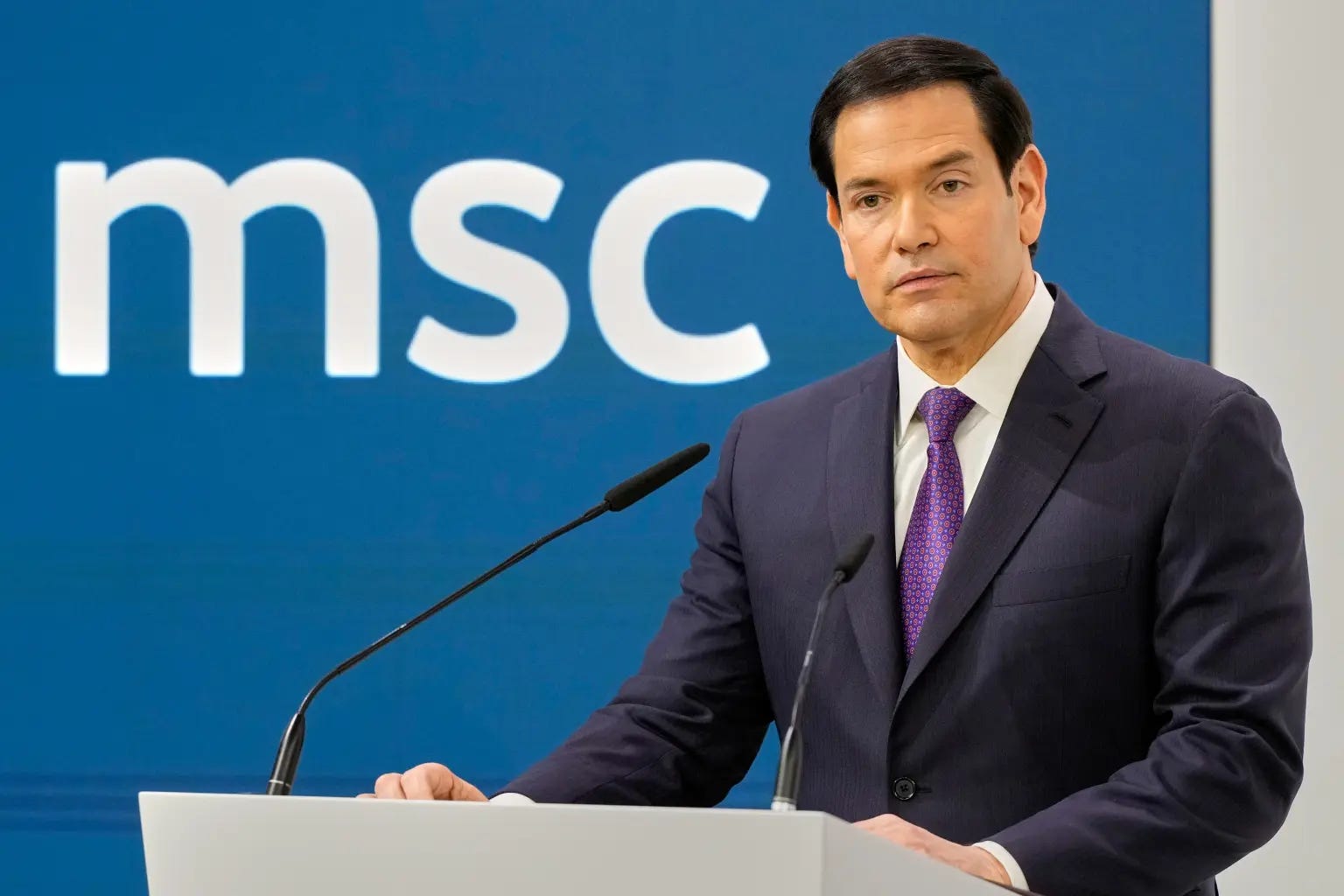
Marco Rubio’s Brilliant Speech
Secretary Rubio’s message, as I heard it, was not one of separation but of shared responsibility.
Callista and I were so struck by Secretary of State Marco Rubio’s speech at the Munich Security Conference that we felt it deserved broader attention. She promptly ensured it was posted on the U.S. Embassy in Switzerland’s social media, and I asked our team at Gingrich 360 to share it as well so more people could see it.
If you have not yet watched the speech, I strongly recommend viewing it rather than simply reading the text. In just more than 20 minutes, the American Secretary of State delivered remarks that were at once reassuring and challenging—offering a sophisticated outline of the concerns shaping the Trump administration’s approach to Europe and the President’s broader strategic objectives.
Reactions in Europe, as well as among globalist-leaning American commentators, were understandably mixed. Secretary Rubio spoke eloquently about the United States as an extension of European civilization and emphasized how deeply intertwined our futures remain. His reflections on the cultural, intellectual, and historical contributions of European immigrants to America—delivered with both warmth and wit—were particularly effective.
Yet beneath the cordial tone and reaffirmation of shared bonds, the speech was unmistakably direct. It reflected a unified view within President Trump’s team: that Europe faces significant internal challenges and that its leadership must confront them with greater urgency and realism.
I appreciated the speech precisely because it conveyed what could be described as “tough love.” For decades, many American policymakers have privately worried that parts of Europe have grown complacent since the end of the Cold War. The collapse of the Soviet Union in 1991 ushered in a period of peace and prosperity, but it also led some to assume that serious geopolitical and economic risks had permanently receded.
Over time, debates about economic competitiveness, energy policy, technological innovation, and defense readiness have widened the strategic conversation between the United States and Europe. As global competition accelerates—particularly in artificial intelligence, advanced manufacturing, and emerging technologies—the question of how Western nations sustain innovation and growth has become increasingly central.
Secretary Rubio’s message, as I heard it, was not one of separation but of shared responsibility. He underscored that the United States and Europe are bound not only by history, but by common values and mutual security interests. After eight decades of partnership—including cooperation that helped secure victory in two world wars and preserve peace during the Cold War—it is both natural and appropriate for American leaders to speak candidly with close allies.
The core question raised by speeches such as this, and by Vice President J.D. Vance’s remarks last year, is a serious one: If American leaders genuinely believe certain trends could weaken the transatlantic community economically, militarily, or culturally, do they not have an obligation to express those concerns honestly—especially among friends?
A future in which Europeans and Americans work together to maximize economic growth, strengthen collective defense, advance technological leadership, and uphold the principles of Western civilization would be profoundly beneficial on both sides of the Atlantic.
In this context, Secretary Rubio’s address was less a criticism than a call to renewed partnership—frank in tone, but rooted in respect, shared history, and a desire to see the transatlantic alliance remain strong for decades to come.
It was, in my view, a thoughtful and consequential speech.
Listen to the latest episode of Newt’s World:
You can manage your subscription preferences to choose the updates, newsletters, and alerts you want to receive on the website.


I think I've just watched the next president of the United States...
Sec. Rubio's speech was beautifully profound, direct, and it was spoken with passion and confidence; it was amazing! Your critique, Mr. Speaker, was very well written and helpful in its summary of the centuries old commonalities as contrasted with the urgency of today's vulnerabilities of Western Civilization.
When Rubio listed the historic European characteristics brought to the New World, he also included the spiritual component; in fact, he mentioned Christianity at least 2 times & I think possibly 3. The position of Europe at this time as compared with the mid 20th century is shocking to say the least, and may have something to do with the shift away from Christianity. Would you please consider exploring this topic for future writings or podcasts?
Thank you,
Linda M