
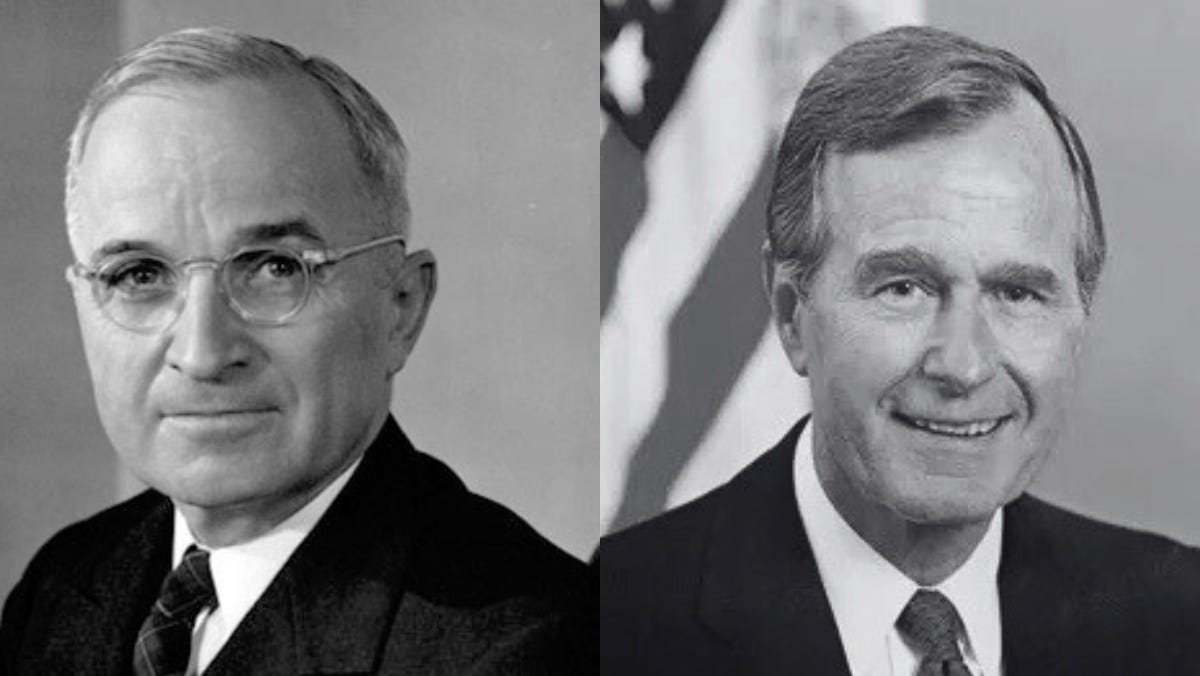
Republicans Must Study Truman and Bush
There are clear principles for winning underdog campaigns against seemingly impossible odds.
The Harry Truman 1940 and 1948 campaigns and the George H.W. Bush 1988 campaign are case studies of what Republicans need to do in 2026.
The key principles are straight forward:
Never give up, outwork your opponent, campaign tirelessly.
Go to the people and talk bluntly about your opponent. Describe them believably—but in strong language that explains their unacceptability. Tie this unacceptability to the lives of your audience.
Stay on constant offense. Force the news media to cover your repetitive consistent attacks even when they hate them and want to change the topic. Use the same language repeatedly so people pick it up and use it (Give them Hell Harry became a spontaneous theme in 1948).
Never allow the campaign to be a referendum on you or your administration. Insist that it is a choice between two different futures and records. In this choice, you are better and your opponent is worse for the lives of the people with whom you are talking.
Arouse and mobilize a coalition in which each component focuses on how much it opposes the other candidate. Avoid trying to forge the coaltions into a single unity (it would lead to hopeless infighting).
Lessons from Three Great Underdog Campaigns
Anti-Republican gloom and doom are the order of the day.
Polymarket is betting 82-19 that Democrats will win control of the House this fall. Many Republicans share the same sense of gloom. As Shakespeare wrote: “Now is the winter of our discontent.” However, it will be “made glorious summer by the sun of York.”
Republicans and MAGA enthusiasts who are on the verge of giving up should read Thomas Paine’s opening of “the Crisis” (published Dec. 19, 1776 at the most depressed point of the American Revolution):
“The summer soldier and the sunshine patriot will, in this crisis, shrink from the service of his country. But he that stands it now deserves the love and thanks of man and woman. Tyranny, like hell, is not easily conquered; yet we have this consolation with us, that the harder the conflict, the more glorious the triumph.”
So, now we face the reality that the news media hates Trump and will consistently try to make us depressed and demoralized. This is not new. They have done it for 10 years. The Democrats desperately want to get back into power so they can impeach the President and much of his Cabinet. Many elements of the establishment would love to have the Democrats back in power.
It also turns out that implementing massive change across the board simultaneously is difficult and will inevitably involve mistakes and arouse opposition—some of it angry and bitter.
As Paine warned the American revolutionaries, if we cave in and allow the old order and its extreme left-wing faction reclaim power, it will do all it can to destroy (us as it did under Joe Biden). But if we find the courage and the resolve to fight back, rally the American people, and tell the truth about the stunningly dishonest and corrupt left, we will win an uphill campaign.
The 2026 election is a key moment in American history. If the Democrats win, they will use every tool to undermine and destroy President Donald J. Trump. The momentum to change the values and structures from the old order to a new, more dynamic, more entrepreneurial, and more pro-American system will have been ended.
If they win this November, the American left will take lessons from Europe and Canada and do everything it can to eliminate unacceptable speech, undermine and criminalize opposition, and make it virtually impossible for Republicans to regain power. They will do everything in their power to rig the 2028 election, so the Republicans cannot win.
Republicans cannot give in to despair, depression, or the unending efforts of the media to shatter our morale and drive us from the campaign battlefield. Therefore, we must study how to be underdogs and wage the kind of campaign that wins against all odds.
The two people who offer the greatest lessons on winning come-from-behind campaigns are Presidents Truman and Bush.
In May 1988, Vice President Bush was 19 points behind Gov. Mike Dukakis.
Two Great Truman Upset Victories
President Truman was so far behind in 1948 that Gallup quit polling, because the race was clearly over. By Gallup’s judgement, Gov. Thomas Dewey had won. Of course, this led to the famous front-page gaff by the Chicago Daily Tribune which wrongly read “Dewey Defeats Truman” on Nov. 3, 1948.
However, 1948 was the second time Truman waged an underdog campaign and won despite the assumption that he was in a hopeless position. In 1940, then-Sen. Truman had served one term. He was a protege of the Thomas Pendergast machine of Kansas City. It had elected him in 1934. But by 1940, Pendergast was collapsing legally and was under assault for corruption. Part of Sen. Truman’s weakness at the beginning of the year was his identity as a Pendergast candidate. He was weak enough that one Missouri politician said, Truman was “politically dead.”
Two major figures, Gov. Lloyd Stark and Congressman Maurice Milligan (the man who had convicted Pendergast of corruption) decided to run against the weak incumbent. It was generally assumed Truman would come in third.
Without money or machine backing, freshman Sen. Truman decided his only hope was an intensive grassroots campaign. He drove 50,000 miles talking with people in every venue, no matter how small. He visited all 114 counties making the case that he was personally honest and had been a solid supporter of President Franklin D Roosevelt and the New Deal.
In a style he would make famous in 1948, Sen. Truman spoke in plain, straight, and tough language. Everything was on the line. As the Historian David McCullough said, “had Truman lost in 1940 he would have been forgotten.”
In fact, Truman’s aggressive, hard-hitting campaign led him to a primary victory with 40 percent of the vote, 31 percent for Gov. Stark, and 29 percent for Rep. Milligan. One part of Truman’s ultimate re-election victory was support from the Missouri African American community which may have had some impact on his strong support for civil rights as President.
The desperate, no resources, come-from-behind nature of the 1940 primary race really set the stage for Truman’s 1948 come-from-behind victory.
It is hard to remember how much trouble President Truman was in by the summer of 1948. He was in the shadow of FDR—who had been a giant towering over American politics and government for 13 years before he died in April 1945. Then-Vice President Truman had only been in office a brief time, and he was virtually unknown. He made a name chairing the Truman Committee on Waste during the war, but he was not a natural national leader.
The Democrats had been in charge 15 years when the Republicans won the Congress in 1946. For two years, the Congressional Republicans dominated domestic policy while Truman focused on the emerging Cold War and a series of international crises and initiatives.
By the summer of 1948, the Democratic Party was splitting into a segregationist wing rallying around South Carolina Gov. Strom Thurmond, a leftist (virtually pro-communist) wing rallying to former Vice President Henry Wallace, and the bulk of the Democratic Party sticking with President Truman—but not particularly enthusiastic about his candidacy.
On the other side, Gov. Dewey had been a crusading anti-corruption New York Attorney General and then Governor of the largest state. Dewey had run a solid race against President Roosevelt in 1944 and was now widely presumed to be the inevitable next President (a confidence which, unfortunately for him, he also felt).
In August 1948 Gallup reported that Dewey was ahead by 50 percent to 36 percent. The Republicans saw this as a snapshot that would not change rather than a motion picture that could get better or worse depending on the campaign.
Truman, counted out by the national media and the elites, reached back for his 1940 playbook. He waged a nonstop train-based campaign seeing thousands of people every day. As the campaign built momentum, crowds grew and people would stand along the track just to see Truman’s train pass.
Truman savaged Dewey, the Republican Congress and Republicans in general. Just three years after the war against Nazi and Fascist dictators, he was referring to some Republicans as fascists. He made fun of Dewey. His central theme was that the Republican Congress was a “do nothing congress.” It was a powerful slogan which he then twisted by asserting that what they did do was bad.
As he was barnstorming and attacking, someone yelled from the crowd “give them Hell Harry.” He replied, “I don’t give them Hell. I just tell the truth and they think it’s Hell!” Crowds started shouting “give them Hell Harry” at every stop and it became the campaigns unofficial slogan.
Despite everything, Truman was still behind in the Gallup Poll by 50 percent to 38 percent as late as Sept. 15, 1948. He began to close the gap, but in the last Gallup Poll on Oct. 15, 1948, Dewey was still ahead 49 percent to 44 percent. Then Gallup quit polling.
In retrospect, there was a big surge toward Truman in October combined with a lot of overconfident Republicans staying home. Truman was also helped by the labor unions and the National Committee for an Effective Congress, which had just been founded and recruited a brilliant class of candidates for the U.S. Senate. In every state, the NCEC candidates ran ahead of Truman and helped him win. Finally, farm prices improved in October and the farm belt voted Democrat.
The 1948 election was an enormous personal victory for Truman. By crushing the congressional Republicans, it also set the GOP back by a generation. The same kind of result in 2026 with a stunning Republican victory would shatter the Democrats and continue America’s shift toward a post-New Deal, MAGA, America First world.
The 1988 Bush Comeback
People forget how big and unlikely the Bush comeback of 1988 was.
We have a retrospective memory of President Ronald Reagan as always being popular. But he had stumbled into the Iran Contra scandal. There was turmoil in the stock market, and after seven years in office the opposition had hardened. President Reagan knew that unless he rebuilt his own popularity there would be no hope of electing Vice President Bush. He also knew that electing his own vice president was a key to his own reputation in history.
Despite all of Reagan’s efforts, Bush was 19 points behind Massachusetts Gov. Dukakis in May. Dukakis had emerged with great news media enthusiasm as a technocrat who had been a successful governor. The news media wanted to position Dukakis as a commonsense moderate and hide his left-wing positions.
Bush had a natural reputation as a moderate who was much less ideological than President Reagan. Indeed, Bush was chosen in 1980 in part to reconcile with the Gerald Ford wing of the party. Furthermore, Bush was a naturally pleasant person who simply did not engage in the kind of rough and tumble debate and speech that was the heart of Reagan’s appeal.
The traditional, minority mentality Republican response to being behind by 19 points would have been to appease the news media and position Bush to the left of Reagan. He would spend a lot of the campaign differentiating himself from Reagan’s policies in the hope that an apologia campaign would attract illusive moderate voters.
However, the three key Bush strategists—Jim Baker, Roger Ailes, and Lee Atwater—all understood that the traditional Republican approach guaranteed defeat. They chose a radically different approach which drew from the spirits of Barry Goldwater and Reagan rather than Dewey and Nelson Rockefeller.
Bush set out to drive Dukakis away from the center and prove he was a totally unacceptable left-wing radical. If you had tested this in May 1988, it would have seemed absurd. No traditional Republican political consultant or pollster would have recommended it.
It turned out, the Bush team was right. Month after month of hard-hitting campaigning had great virtue. As Henry Kissinger once said, it was what truly began to dissolve the news media’s version of Dukakis.
Because the left was so shattered by the 1988 defeat—which it knew must have been stolen— the left spent a lot of effort for years smearing the people who did it and lying about the issues.
But let’s be clear: Dukakis was an ACLU member, and in most of America that meant liberal. Dukakis had vetoed a bill to require public school teachers to say the pledge of allegiance, and most Americans thought that was weird. There was a fight in the House as Republicans insisted on opening every day with the Pledge. Suddenly, the Bush campaign had an overwhelming number of American flags at every stop.
Dukakis had signed a program to allow murderers to have furloughs from prison on the weekends. He then defended the program—even when some of the murderers on furlough went on to rape and kill people. The Lawrence Eagle Tribune won a Pulitzer Prize for a 13-part series on this insane program. The Reader’s Digest published an Article in July called “Getting Away with Murder,” and Dukakis’s approval rating dropped within days of the magazine arriving at people’s homes. Fox TV (Fox News did not exist) ran a 30-minute special on the murderers furlough program, and Dukakis’s support for it. The Republicans ran a devastatingly effective commercial which featured one murderer, Willy Horton (produced by Bush consultant Larry McCarthy). The left, in its usual inability to understand that people are against releasing murderers, attacked the ad as racist and spent several years driving Ailes out of political consulting. This led him in a grand irony to then create Fox News.
Bush won the economic argument with his pledge “read my lips, no new taxes.”
After attacking Dukakis for being weak on defense, the Democrat proved the Republicans were right by riding in a tank and looking ridiculous with a helmet that was too small for his head.
The 1988 Bush campaign was psychologically and ideologically a break from Bush’s career before and after. In many ways, it was Reagan’s third victory as an ideological, aggressive, hard-hitting assault on the left.
Importantly, it worked—when the odds indicated it would not.
Conclusion
Truman in 1940 and 1948 and Bush in 1988 were in much greater trouble then President Trump and the Republicans are in 2026. If we run a principled, well thought out, underdog campaign, we have every likelihood of winning a shocking victory which will shatter the left and validate the rise of President Trump and MAGA-Trumpism as an historic turning point in American history.
Listen to the latest episode of Newt’s World:
You can manage your subscription preferences to choose the updates, newsletters, and alerts you want to receive on the website.


Absolutely fantastic piece Mr. Speaker, just brilliant from start to finish and perfect for the moment!