


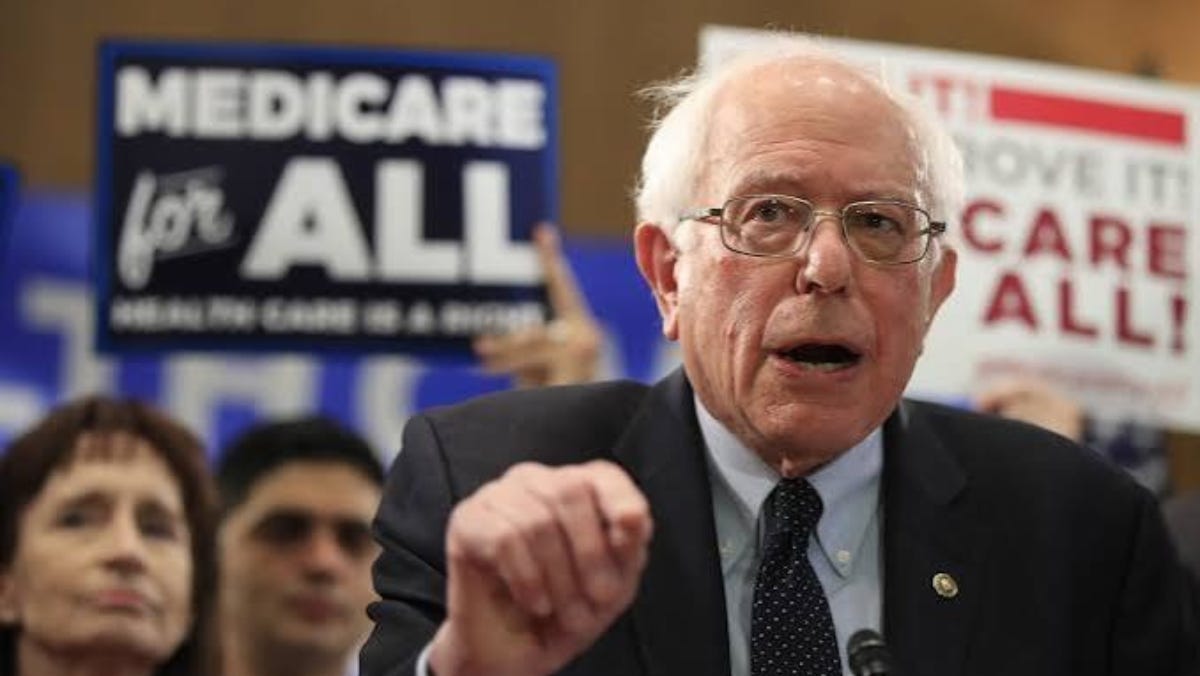
Democrats who favor Medicare for All have given Republicans a huge opportunity.
Far from hiding from the healthcare debate, Republicans should be piling on and forcing Democrats to defend their crazy idea of a Washington-run national healthcare system. Republicans should also offer a positive alternative.
There are three major reasons to reject Medicare for All.
First, Sen. Bernie Sanders’ Medicare for All bill could force American taxpayers to pay for healthcare for illegal immigrants. The bill makes residency, not citizenship, the basis for coverage and contains no explicit exclusion for people here illegally. Sanders himself has said they would be covered.
An April 2025 poll by America’s New Majority Project found that 62 percent of voters opposed states using taxpayer money to provide Medicaid benefits for illegal immigrants, with 43 percent strongly opposed. Another 62 percent favored a federal law prohibiting it. Three out of four Americans supported stronger identity verification for Medicaid applicants, compared with just 18 percent opposed.
The questions were about Medicaid, not Medicare for All, but they reveal strong opposition to taxpayer-funded coverage for illegal immigrants.
As inarticulate as the GOP often is, Republicans should be able to win 75 percent-to-18 percent debates.
Second, Medicare for All would create an enormous new Washington healthcare bureaucracy. This is not speculation. Under Sanders’ bill, Washington would determine hospital budgets, set doctors’ fees, decide which drugs are covered, and prohibit private insurance that duplicates government coverage.
There are serious problems with today’s insurance companies. They deny claims, restrict networks, and bury doctors in paperwork. But the answer to private-sector bureaucracy is not an even bigger government bureaucracy.
Under Medicare for All, hospital budgets are described as “negotiated.” But when Washington writes the rules and controls nearly all the money, what kind of negotiation is that?
That is not simply government paying the bills. It is government controlling healthcare.
Third, guaranteeing health insurance is not the same as guaranteeing healthcare.
Congress can pass a law guaranteeing every American healthcare. It cannot pass a law creating more doctors, hospital beds, or available appointments.
Consider Britain. Under England’s National Health Service, patients generally have a legal right to begin nonemergency specialist-led treatment within 18 weeks. Yet in July 2026, the NHS had 7.3 million cases on its waiting list, including more than 2.5 million who had already waited longer than 18 weeks.
The government guaranteed treatment within 18 weeks. More than one-third of those on the waiting list had already waited longer.
Canada offers a similar warning. A 2023 international survey found that only 31 percent of Canadians who needed a specialist saw one within a month, compared with 57 percent of Americans. One-in-10 Canadians waited a year or longer.
Waiting for care is one problem. Government deciding which treatments to cover is another.
In Britain, the government refused to cover Enhertu, a treatment shown to extend the lives of patients with advanced breast cancer, because it was considered too expensive for the benefits provided. American patients had access to the treatment more than four years before Britain began covering it in September 2026.
That is the difference between promising healthcare and delivering healthcare. Or as Dick Morris warned, Medicare for All could become “Medicare for None.”
However, the Republican advantage is more than an argument against the Democrats’ proposal.
With President Donald J. Trump’s leadership, Republicans have been developing big ideas to lower costs, improve access, and give Americans more control over their healthcare.
The President’s Great Healthcare Plan would send assistance directly to eligible Americans instead of insurance companies, require plain-English insurance information, and hold powerful healthcare institutions accountable.
TrumpRx is already helping Americans find lower cash prices for participating prescription drugs and compare prices for hundreds of generic medicines.
These are important steps toward a dramatically better system. Republicans should build on them.
As healthcare economist John Goodman has argued, two additional reforms could give Americans even more control.
First, let Americans buy insurance that meets their needs and budgets. Obamacare requires individual and small-group plans to cover a Washington-defined list of essential health benefit categories. Americans should be free to choose their own coverage instead of being forced to buy what Washington mandates.
Second, let insurers offer non-network plans. Patients should be able to choose any properly licensed doctor without being restricted to an insurer’s approved network. Their coverage should retain its value when they choose that doctor.
I would add a third reform: build on President Trump’s initiatives and extend transparency and accountability throughout the healthcare system. Before scheduled treatment, Americans should know the price, what insurance pays, and what they will owe. They should know which doctors and hospitals deliver the best results. Insurers, hospitals, and middlemen should be accountable for prices, performance, and treatment of patients. The Patients Deserve Price Tags Act would accomplish much of this and should be passed and sent to the president before the end of the year. Republicans should also protect Medicare and Medicaid by rooting out fraud.
The choice should be clear. Democrats want Washington to control healthcare. Republicans should offer lower costs, more choices, and decisions made by you and your doctor — not Washington and insurance company bureaucrats.
That is a debate Republicans should be eager to have.

How to Win 2026

The 2026 midterms could be a defining moment for America. Follow Newt Gingrich and Gingrich 360’s latest columns and analysis on the ideas, policies, and strategies Republicans need to win the big arguments, grow the American majority, and deliver real results for the American people.
How to Win 2026 is part of a larger effort to identify the ideas, policies, and arguments that can create a lasting American majority.
Explore our latest columns, research, commentary, and analysis on the Republican Opportunity in 2026.
Latest From America’s New Majority Project

You can manage your subscription preferences to choose the updates, newsletters, and alerts you want to receive on the website.