


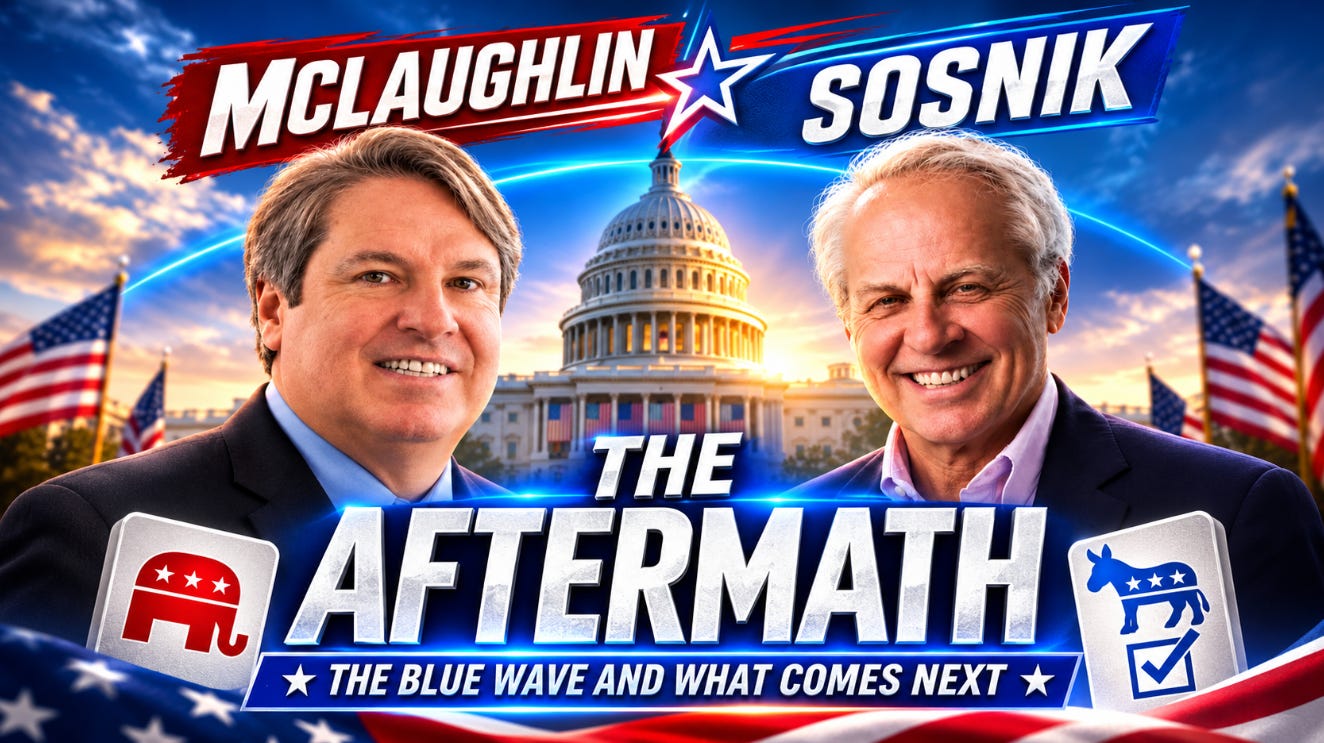
Newt Gingrich Joins Political Strategists John McLaughlin and Doug Sosnick to Analyze the 2026 Midterm Election Results and the Road to 2028.
The 2026 midterm elections delivered a sweeping Democratic victory, handing the party control of both the House and Senate and producing unexpected results in traditionally Republican strongholds, including Texas, Kansas, and South Carolina. What caused the political landscape to shift so dramatically? In this episode of Newt’s World, 50th Speaker of the House Newt Gingrich reunites with Republican pollster John McLaughlin and Democratic strategist Doug Sosnick to examine what the polls predicted, where Republicans fell short, and why voters delivered such a decisive message. Their discussion explores the impact of rising living costs, voter turnout, immigration policy, candidate quality, and the challenge of communicating economic progress to Americans still struggling with everyday expenses.

But the consequences extend far beyond November. With Democrats preparing to govern Congress and Republicans confronting difficult questions about their political strategy, the conversation turns to the future of both parties. Gingrich, McLaughlin, and Sosnick examine the surprising Democratic victories in Texas, the changing composition of the Republican electorate, and the possibility that the 2028 presidential election could mark a generational turning point in American politics. From the growing influence of artificial intelligence to the emergence of new political coalitions, their analysis raises a fundamental question: Will either party learn the lessons of 2026 and develop a compelling vision for America's future?
Listen to their conversation below, or scroll down for an edited transcript.
Edited Transcript
This conversation has been condensed and lightly edited for clarity.
Newt Gingrich
My guests today are two of the country’s sharpest political analysts. John McLaughlin is CEO and partner at McLaughlin & Associates, and Doug Sosnick is a research fellow at Harvard Kennedy School.
In October, John and Doug joined me to size up the midterms. Now the votes are in, and Democrats have won control of both the House and Senate, including Senate seats in Texas, Kansas, and South Carolina.
They’re back to tell us whether the polls got it right, what drove the results, and what comes next.
I’m grinning because both John and I realized that Doug was the wise person who actually understood what was going on. The two of us feel a little chagrined.
Doug, how close were the results to what you expected?
Doug Sosnick
I always thought there were two competing factors. One was the historical precedent, which suggested in virtually every metric that this would be a blue wave election.
On the other hand, structural changes in American politics have left us with far fewer competitive seats. I thought that would put a ceiling on Democratic wins.
I thought Democrats could win up to six Senate seats, and it looks like the number could reach nine. In the House, I originally expected gains in the mid-20s, then thought they might approach 30. Now I think they’ll be closer to 50.
I expected a very good Democratic election, but the structural ceiling I anticipated wasn’t there.
Newt Gingrich
John, what was your sense?
John McLaughlin
I always thought we’d have record turnout. It appears that 124 million people voted, compared with 118 million in 2018.
I was hoping we could keep the Senate. We knew the House was going to be difficult.
The Democrats had a very simple message: They were anti-Trump. They focused on maximizing turnout among voters who disapproved of the president’s policies.
Republicans never developed an effective contrast. They didn’t have a unified message or a strategy as a party.
According to the exit polls, independents voted 56% to 39% for Democrats in House races. That was a major problem.
Doug Sosnick
It’s much harder for the party in power to make a midterm election about a choice between two alternatives.
Although the raw turnout was higher than in previous midterms, turnout as a percentage of eligible voters was actually lower than in 2018 and 2022.
I think we’ll find that Democratic turnout was closer to presidential-election levels, while Republican turnout wasn’t.
And I believe the way President Trump handled the election cycle significantly helped Democrats. From candidate decisions to campaign spending and his public messaging, I couldn’t have scripted a more effective approach for Democrats.
John McLaughlin
It was such a contrast from 2024, when President Trump was focused on winning, listening to polling, and developing a clear message.
In 2024, we had a contrast with Joe Biden and Kamala Harris. This time, Republicans never developed that kind of focus.
The economy is a good example. In our post-election survey, 50% of voters identified the economy as their top issue, and 27% specifically mentioned higher prices and inflation.
People didn’t necessarily believe we were in a recession, but they still thought the economy was getting worse.
When we presented positive economic information, their perceptions changed dramatically. But they hadn’t heard that message during the campaign.
Newt Gingrich
About three months ago, I said, “Tell me the price of gasoline on Labor Day, and I’ll tell you the outcome.”
I went to fill up my truck recently, and I was standing at the pump getting very frustrated because gasoline was more than $4 a gallon. I have a big tank.
There was a common-sense, real-life level where people were feeling pain, even if things might improve in the long run.
I think Susan Collins’ real opponent in Maine was the price of heating oil. At this time of year, people are filling their tanks for winter, and heating oil prices were approaching record highs.
Am I placing too much importance on this?
Doug Sosnick
No. The price of gasoline on Labor Day was the highest ever recorded for that holiday.
We have an economy where aggregate economic numbers can look excellent, but the benefits aren’t distributed evenly.
Many Americans are living paycheck to paycheck, and inflation acts as a highly regressive tax.
The broader problem for both Biden and Trump has been that strong national economic statistics don’t necessarily reflect what people experience in their daily lives.
John McLaughlin
The top issue among Hispanic voters was also the cost of living and prices.
When you’re looking at undecided voters, you think you might be able to persuade them until they stop to buy gasoline.
We had a poll showing that 80% of voters supported suspending the gasoline tax. We thought Congress should have considered suspending it through the end of the war.
But that never happened.
We also saw Democrats regain support among younger voters, African Americans, and Hispanic voters.
Younger voters are particularly affected by credit card debt and high interest rates. You can tell them inflation has declined, but their monthly credit card bills tell them something different.
Doug Sosnick
I wouldn’t underestimate the impact of immigration enforcement on Hispanic voters.
And in the South, the surge in Black voter turnout following Supreme Court rulings and redistricting was important.
Those factors helped shape the election in ways that went beyond the economy.
Newt Gingrich
Let me switch gears. There are two Senate races still outstanding.
In Mississippi, Democrat Scott Colom is ahead by about 1,800 votes, with additional ballots to count. I would never have expected Cindy Hyde-Smith to be in this position at the beginning of the year.
What explains that?
Doug Sosnick
Two factors stand out.
One is corruption. When voters are struggling to afford everyday necessities, allegations of corruption become more important. Democrats connected that issue directly to people’s lives.
The second is candidate quality.
Republicans had some weak incumbents and difficult recruitment decisions, while Democrats did a better job finding strong candidates who reflected the communities and states where they were running.
That matters enormously, particularly in a wave election.
Newt Gingrich
The other outstanding race is Alaska, where Mary Peltola leads Senator Dan Sullivan by a narrow margin in first-choice votes.
Alaska uses ranked-choice voting. If neither candidate reaches a majority, votes are redistributed according to voters’ subsequent preferences.
Some Republicans have suggested they wouldn’t seat her if she wins.
But it seems to me that Alaska has an established election system, and whoever wins under that system wins. What am I missing?
Doug Sosnick
You’re not missing anything.
Alaska has its own election system, and the courts have already addressed its legitimacy.
There are still ballots to count, particularly from remote communities that can be reached only by air or boat.
Once the ballots are counted and the ranked-choice process is completed, the result should stand.
John McLaughlin
I agree that Alaska has an established ranked-choice voting system and that the courts will uphold it.
There is a separate question about whether campaign laws may have been violated in the recruitment of another candidate named Dan Sullivan.
If there were violations, that’s a matter for legal authorities to investigate. But it’s separate from the basic operation of Alaska’s election system.
Doug Sosnick
And we shouldn’t underestimate how expensive everyday life is in Alaska.
So much has to be transported by air, and higher energy and heating costs have added to voters’ dissatisfaction.
Newt Gingrich
Turning back to the House, NBC is projecting 259 Democrats, which would be the largest Democratic majority in many years.
It reminds me of the large majority Democrats won in 2008, which was overturned just two years later when John Boehner ran a disciplined campaign centered on the question, “Where are the jobs?”
That suggests Hakeem Jeffries could be a very effective Speaker, with a majority large enough that individual factions won’t be able to dictate everything.
Doug Sosnick
I agree.
What’s interesting is that the remaining House Republican caucus is now more closely aligned with Trump because many of the moderates were defeated.
Republicans face a difficult question about where the party goes next.
I could see three broad groups emerging: MAGA Republicans, America First Republicans who aren’t necessarily MAGA, and the remnants of the traditional Republican establishment.
Those divisions could become increasingly important.
Newt Gingrich
There’s a danger in becoming too comfortable in the minority.
It’s much easier to oppose legislation than to take responsibility for governing.
But what you want is a party seeking to become a majority, not a party that’s happy remaining in the minority.
Republicans may face bigger challenges than Democrats in figuring out where they go from here.
John McLaughlin
One of the biggest changes under Donald Trump is that the Republican Party has increasingly become the party of working-class voters.
Those voters began moving toward Republicans before Trump, and he became their leader.
The question is whether they’ll remain Republicans after Trump and whether Democrats will try to win them back.
There’s also a turnout problem. Many Trump voters don’t participate at the same rate when he’s not on the ballot.
That was a major factor in this election.
Doug Sosnick
The broader issue is that Americans dislike both parties and don’t want either party controlling the White House indefinitely.
I think the 2028 election will depend heavily on whom Democrats nominate.
If Democrats choose someone the broader electorate isn’t comfortable supporting, voters could turn back to a Republican.
John McLaughlin
Presidents have recovered from difficult midterms before.
Ronald Reagan rebounded after 1986, and Bill Clinton recovered from the Republican victories in 1994.
If the economy continues to improve, the political environment could change again before 2028.
Newt Gingrich
One of the biggest surprises to me was Texas.
James Talarico went from leading by a relatively narrow margin to winning by about 12 points, and Republicans lost statewide races across Texas.
If we’d discussed that possibility in January, I don’t think either John or I would have believed it.
Isn’t Texas one of the most surprising results?
Doug Sosnick
It certainly surprised me.
I’ve always thought Texas and Florida were difficult targets for Democrats.
I don’t think Texas has suddenly become a reliably Democratic state, but it’s clearly competitive under the right circumstances.
Candidate quality was important. Ken Paxton was an extraordinarily weak Senate candidate, and Governor Greg Abbott faced challenges of his own.
Immigration enforcement also had an impact, particularly among Hispanic voters in South Texas.
It was a combination of factors.
John McLaughlin
Texas may have been the biggest shock.
It had become a central stronghold of the Republican Party, much as Ohio once was.
But after voters supported Talarico, they continued voting Democratic down the ballot.
Republicans failed to develop a compelling message to counter that momentum.
Losing the governorship and statewide offices makes this one of the toughest lessons Republicans will have to confront.
Newt Gingrich
When you look at what happened in Texas and Michigan, it demonstrates how extensive the Republican Party’s rethinking needs to be.
Doug Sosnick
I think voters are also becoming tired of the nastiness and outrageous rhetoric in politics.
Some successful Democratic candidates campaigned with a different tone.
The controversy surrounding Vivek Ramaswamy’s campaign advertisement in Ohio, and JD Vance’s defense of it, could have important implications for the Republican presidential nomination.
The country may be moving toward a different standard for what voters are willing to accept.
Newt Gingrich
I found that advertisement deeply offensive, particularly because it involved a painful family situation.
It was an extraordinary political mistake.
And perhaps it should have been another warning that this wasn’t going to be a good Republican year.
But let’s look to the future.
Doug, what does your instinct tell you about the Democratic presidential nominating process?
Doug Sosnick
Democrats have spent much of the last 11 years defining themselves by opposition to Donald Trump.
That has allowed the party to paper over significant internal differences.
Now we’re going to find out who represents the next generation of Democratic leadership.
There are numerous potential candidates, most of whom are center-left. The progressive wing is energized, but it’s not yet clear who will emerge as its strongest candidate.
I don’t see an obvious frontrunner.
The eventual nominee will need to represent change rather than the status quo. Americans believe many of their institutions aren’t working, and they want someone willing to address that.
Historically, both parties have generally gravitated toward candidates they believe have the best chance of winning.
Newt Gingrich
I think we’re looking at an unusually dynamic presidential nominating process.
If JD Vance has been politically weakened by the election, the Republican nomination could be more open than we expected.
Democrats are also heading toward an open competition.
There haven’t been many occasions in American history when both parties have faced genuinely open nomination contests at the same time.
Doug Sosnick
And those contests will intersect with the policy debates happening in Washington.
The positions presidential candidates take will influence Congress, and congressional proposals will influence the presidential campaign.
I think we’re entering a transition between the age of Trump and the period that comes after him.
The 2028 election could resemble 1960, when America experienced a generational change in leadership.
Television helped redefine politics in 1960. I think artificial intelligence could redefine politics in 2028.
The debates in 2027 and 2028 may ultimately determine the direction of American policy when the next president takes office in January 2029.
Newt Gingrich
John, what’s your thought?
John McLaughlin
I agree that 2028 will be wide open.
Republicans and Democrats have been closely balanced in the electorate for several election cycles.
We’ve essentially been watching a competition between the Obama coalition and the Trump coalition.
Primary elections are influenced by ideology, demographics, geography, and the order in which states vote.
On the Democratic side, Kamala Harris currently benefits from high name recognition and support among African American voters.
But we recently conducted a California poll showing Alexandria Ocasio-Cortez ahead of Gavin Newsom, largely because of her support among liberal and Hispanic primary voters.
That illustrates how unpredictable the nomination process could become.
Doug Sosnick
Our politics have been remarkably stable in their partisan divisions for decades.
But this election may suggest that some of those divisions are beginning to loosen.
I don’t think Democrats can assume they’ll carry every state they won in 2026 when 2028 arrives.
Still, we could be looking at a different Electoral College map.
John McLaughlin
There’s also going to be a generational change in American leadership.
Who the parties nominate, and the coalitions those candidates build, will shape the election.
One of the clearest lessons from 2026 is that Republicans didn’t have a strategy for winning the middle.
They didn’t win moderates or independents.
Presidential elections depend on persuading those voters, not simply energizing a party’s primary base.
Newt Gingrich
Well, we might actually have to go back to solving problems.
That’s my optimistic thought.
John and Doug, thank you both. I always find these conversations fascinating, and I’m grateful that you bring such different perspectives and so much experience to the discussion.
I hope we can get together again early next year.
About the Guest
John McLaughlin is CEO and partner at McLaughlin & Associates, a national survey research and strategic consulting firm. With more than four decades of experience in political polling and strategy, he served as an adviser and pollster for Donald Trump’s 2016 presidential campaign. He is also a founding partner of Opineones Latinas, which researches the views of Latino voters nationwide, and writes a regular polling column for Newsmax.
Doug Sosnik is a research fellow at Harvard Kennedy School’s Center for Business and Government. He served for six years as a senior adviser to President Bill Clinton, including as White House political director and senior adviser for policy and strategy. Previously, he was chief of staff to Senator Chris Dodd of Connecticut. He publishes political analysis examining elections, voter behavior, and the changing American political landscape.

Latest from America’s New Majority Project

You can manage your subscription preferences to choose the updates, newsletters, and alerts you want to receive on the website.