
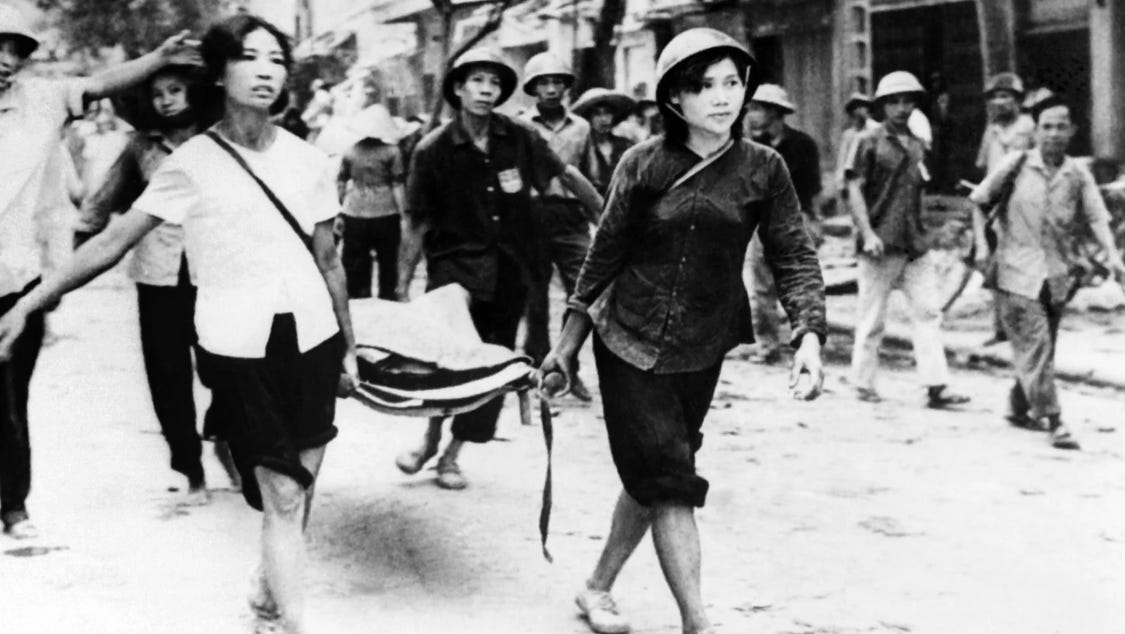
Washington and Tehran Should Study Christmas 1972 in Hanoi
President Donald J. Trump is trying to pressure Iran’s religiously inspired dictatorship to agree to a tough series of restrictions to get to a better economic future.
It is also clear that President Trump is operating as the leader of a coalition — and not only as an American leader. While the anti-Trumpers claim that Trump is an isolationist and inclined to weaken America’s alliances and go it alone, he has consistently been careful with our traditional allies in Israel and a wide range of Arab countries with whom he has been working since his first term.
It was no accident that his first presidential trip was to Riyadh, where the King of Saudi Arabia brought together 58 majority Muslim nations to meet with the new President. It is no accident that the Abraham Accords brought together Arab nations, Israel, and the United States.
Our Arab allies have played a major role in convincing President Trump to go carefully and to exhibit a level of patience we don’t normally associate with the Trump Presidency.
Because his coalition allies are concerned about a potential Iranian assault on their oil fields and infrastructure, President Trump has been much more tolerant of Iranian game playing than I would have thought possible.
Hopefully, the Iranians will come to realize they are sitting on the edge of a disaster and will agree to an honest truce with clear and enforceable commitments. If this happens, the war will end on a positive, mutually agreed vision.
However, the Iranians must be convinced that there is an alternative track open to the United States. If the Iranians think holding out on keeping the Strait of Hormuz and the Persian Gulf closed is to their advantage, they may simply keep playing rope-a-dope. They may always have a reason to do nothing — and agree to nothing — while waiting for the world’s need for oil and the American voters’ anger over gasoline prices to force President Trump and the coalition he leads to accept a terrible deal.
It might be helpful for them to look back to December 1972, when the North Vietnamese made a similar calculation. The peace talks in Paris between the United States and North Vietnam had been underway since May 1968. There were 201 public meetings and 45 secret meetings between North Vietnamese diplomat Le Duc Tho and American Secretary of State and National Security Adviser Henry Kissinger.
There had also been earlier bombing pauses with no positive reaction from North Vietnam.
By 1972, President Richard Nixon and Secretary Kissinger decided that nearly four years of talking diplomacy had failed, so they moved to coercive diplomacy. They reasoned that this coercion had to be so severe and overwhelming that it would break the North Vietnamese ability to resist.
On Dec. 18, 1972, Operation Linebacker II began. For 11 days, B-52 heavy bombers pounded the capital of Hanoi and the port of Haiphong. With 700 sorties from 1,800 miles away in Guam, the bombers hit the North Vietnamese relentlessly. Nearly 20,000 tons of bombs were dropped. The following month, the four-year stalemate broke. The Paris Peace Accords were signed and North Vietnam released our American prisoners of war.
The American bomber force was bigger back then (some 420 B-52s in the fleet with 200 dedicated to Vietnam compared to 76 now available). However, we now have 45 B-1 bombers and 19 B-2 bombers. Today’s bombs are also dramatically more accurate than the 1972 versions.
Ideally, there will be no need for coercion.
The American-Israeli-Arab coalition would be delighted to reach an agreement with no more bombing.
But, as Prussian King Frederick the Great once said, “diplomacy without arms is like music without instruments.” We do not want to be coercive, but we do want an agreement that protects our allies, interests, and the world’s access to the Persian Gulf.
The Iranians should understand: Patience is not a sign of weakness. Trying to be reasonable is not a sign of timidity.
In the end, we will find a way to a kind of peace with which we can live.
Of course, America will do everything it can to achieve this goal without more violence.
But if the Iranians force us into coercive diplomacy, to paraphrase President Ronald Reagan, they ain’t seen nothing yet.
Latest from Newt’s World:
You can manage your subscription preferences to choose the updates, newsletters, and alerts you want to receive on the website.


Regarding the war with Vietnam, the United States pulled out of there for goo in April of 1975 and let the North take over. So I consider that a victory for North Vietnam. What happened? How can you explain that?