
What if Pearl Harbor Never Happened?
This is how we should think about the surprise attack on Pearl Harbor 84 years later.
On Sunday, we observed the 84th anniversary of Japan’s surprise attack on Pearl Harbor. There are relatively few Americans alive today who remember that dreadful day – and many who only know about it from history class.
This struck me, because I realized America’s institutional memory of the attack and its implications is in danger of fading – and we must not let it.
The attack on Pearl Harbor was one of the most decisive moments in American history. There are profound moral and emotional reasons that we remember that infamous Sunday morning 84 years later.
The audacity of the strike on an American naval base was a huge shock. That it occurred on a Sunday morning increased people’s sense of rage and moral righteousness. The bombing galvanized the American people into a deep emotional determination to destroy the Japanese Empire.
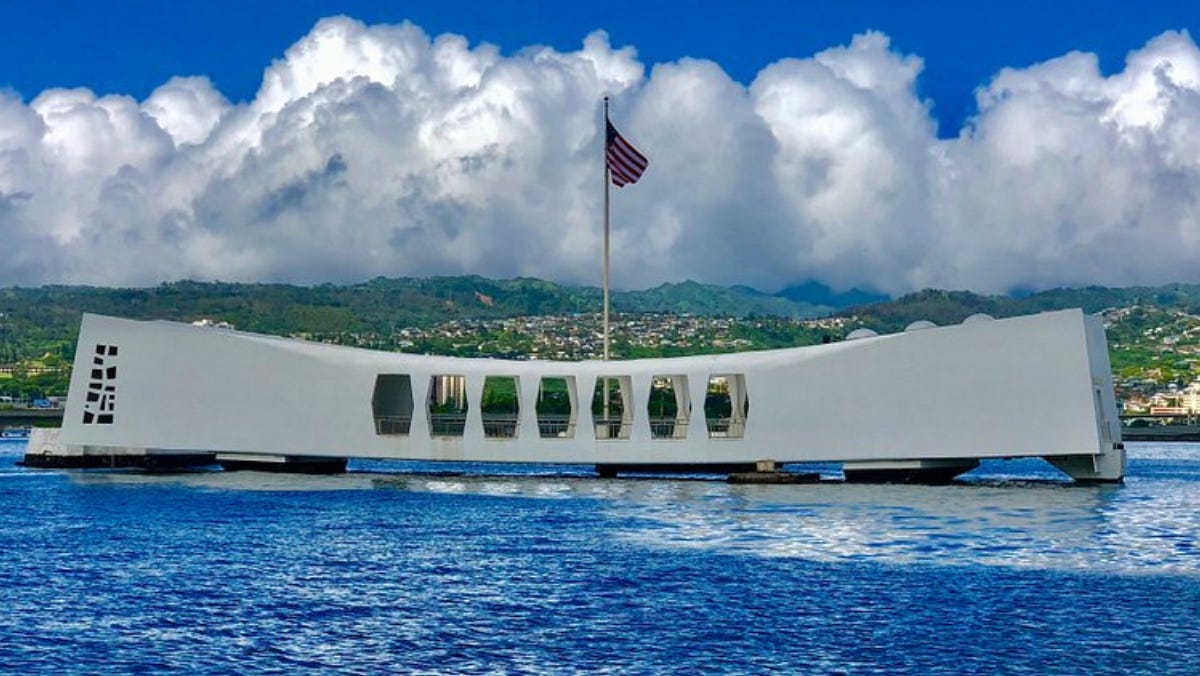
The tragedy of losing 2,403 American servicemembers and civilians in one morning rippled through the whole country. The stunning disaster of the USS Arizona (which sank with 1,177 crew members killed and only 335 survivors) became a national symbol of loss. Even today, visiting the memorial to battleship at Pearl Harbor is a somber and sobering experience.
The patriotic fervor that swept the United States is evident in one of President Franklin D. Roosevelt’s greatest speeches, which he made to a Joint Session of Congress (and the nation by radio broadcast). In only 518 words over six and a half minutes, President Roosevelt declared Dec. 7, 1941, would be “a day that would live in infamy.”
As a student of history (and an occasional participant in making history) I think a useful mental exercise can be built around the facts of Dec. 7, 1941.
My good friend and coauthor Bill Forstchen and I wrote two alternative histories of that day from an immediate, tactical perspective – “Pearl Harbor: A Novel of December 8th” and “Days of Infamy.” Note that we cited Dec. 8, because the Japanese Imperial Navy measured everything by Tokyo time. From Japan’s perspective, that was the date of the attack. Those novels were tactical alternative histories because they assumed the basic facts of a Japanese surprise attack would happen, and we explored some changes that could have had a big impact on the immediate fight.
We suggested that Japanese Admiral Isoroku Yamamoto, the most famous leader in the Japanese Navy, would have been talked into leading the fleet at Pearl Harbor. There were two key facts about Yamamoto that appealed to us. First, he led the development of Japanese naval aviation and captained an aircraft carrier. The admiral chosen to lead the specific Pearl Harbor attack, Admiral Chūichi Nagumo, was a cruiser captain who did not fully understand how to use naval aviation. Second, Yamamoto had a reputation as a aggressive gambler and spent time in casinos in Europe and America. Admiral Nagumo was cautious. He refused to stay and finish the job even though they had achieved complete surprise and decisively crippled the American fleet. We reasoned that Yamamoto would have seen the opportunity to stay and do vastly more damage (for example if the oil farms had been destroyed, the entire fleet would have to have retreated to San Diego because there would have been no fuel in Hawaii).
Forstchen and I had a lot of fun playing “what if,” but it occurred to me recently that we wrote at the tactical level rather than the grand strategic level.
A much more interesting, and I think much more educational, approach would be to ask the big strategic question: What would the world have been like if the Japanese had decided not to attack at Pearl Harbor?
Prior to the attack, the American people were divided. They had come out of World War I with great opposition to getting involved in European wars. The attitude toward the Pacific and the Japanese was even more skeptical of American involvement.
When the Japanese attacked the USS Panay, a gunboat, on Dec. 12, 1937, President Roosevelt had limited options. This was in part because many Americans wanted to know why we even had gunboats on a Chinese river.
One alternative history could have included a better recognition by the Japanese leadership that the American people were not eager to go to war with Japan. And that President Roosevelt was even finding it hard to convince them to take steps to support Britain after the fall of France. It is hard to imagine now, but Americans were split over the threat of a Nazi dominated continent and the potential collapse of the British. There was strong isolationist sentiment. Its most popular spokesperson was Charles Lindbergh, who was famous for flying solo across the Atlantic.
In fact, from Sept. 3, 1939 until Dec. 6, 1941, President Roosevelt was bobbing and weaving, zigging and zagging, and inventing small steps to help Britain survive despite congressional resistance and popular opposition to American involvement.
Remember that as late as Aug. 12, 1941, after the German invasion of the Soviet Union, the draft for American soldiers was only approved by a 203 to 202 vote after an extraordinary lobbying effort by General George Marshall. (Roosevelt asked Marshall to take the lead on the grounds that key elements of Congress no longer trusted the President.)
Furthermore, the United States had consistently refused to develop Guam as a military base to avoid threatening or irritating the Japanese.
The Japanese historian Akita Iriye, in his brilliant study of Japan’s decision to go to war, argues that the debates at senior levels prove that the Japanese leadership was frightened that the US naval building program would give America overwhelming strength by 1943 or 1944. If combined with continued restrictions on the sale of aviation fuel and key minerals, they worried it would leave Japan helpless. They decided to attack America as an act of desperation.
However, imagine if they had held off on launching the war with America. Roosevelt was doing everything he could to get American strength focused on the Atlantic – not the Pacific. Roosevelt clearly saw Adolf Hitler and Nazi Germany as the primary and most dangerous enemy.
If there had been no Sunday morning surprise attack on Pearl Harbor, it is hard to see how Roosevelt could have convinced the American people to start a war in the Pacific. Furthermore, Hitler solved Roosevelt’s difficulties by voluntarily declaring war on the United States when he did not have to. Roosevelt’s problems would have been much greater if Germany and Italy had avoided declaring war. The pressures for a Pacific-first strategy would have been overwhelming among the American people. Hitler’s declaration of war (and Congress’s responding declaration of war on Germany and Italy on Dec. 11, 1941) freed Roosevelt to focus most of our resources on the Atlantic and Europe.
What if Japan had not launched an attack at Pearl Harbor? Also, what if Hitler had not declared war on the United States? These are great case studies that remind us history must be studied for what happened – and for what might have happened. History is a discipline for thought. It is not just about memorizing “dead facts.” When taught dynamically, history becomes more interesting and more useful.
This is how we should think about the surprise attack on Pearl Harbor 84 years later.
Listen to the latest episode of Newt’s World:
You can manage your subscription preferences to choose the updates, newsletters, and alerts you want to receive on the website.


