


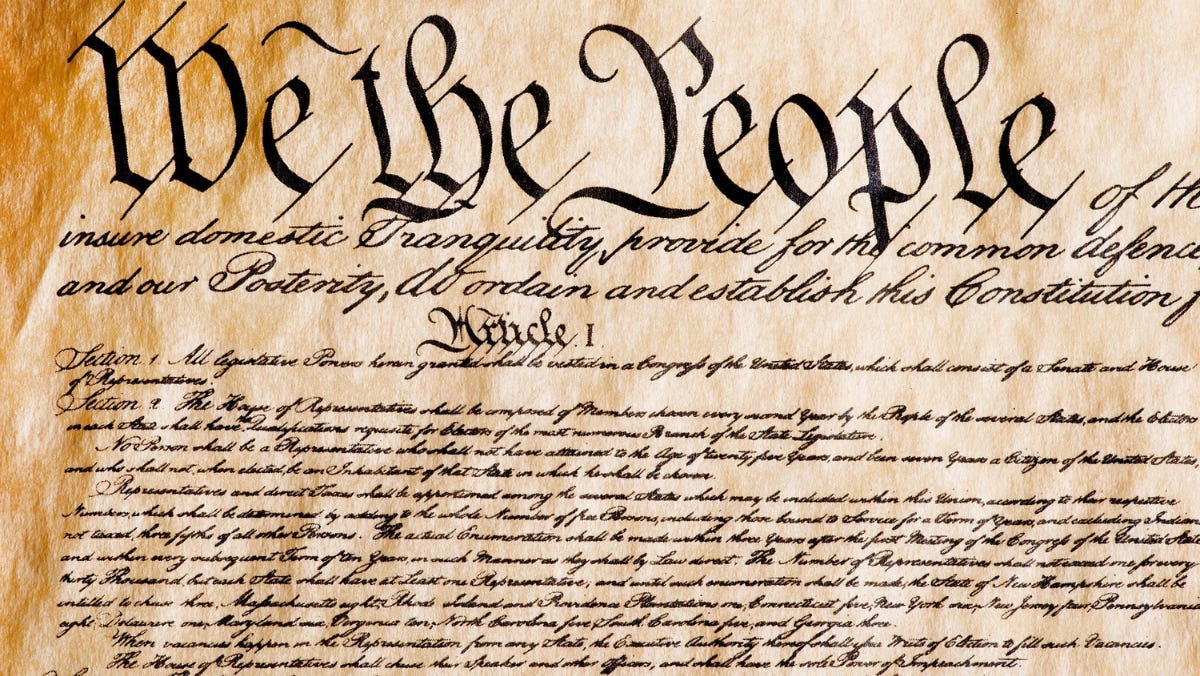
In 2004, Democratic Sen. Bob Byrd of West Virginia passed a small amendment to a funding bill to create Constitution Day. Sen. Byrd always carried a copy of the Constitution in his coat pocket and believed most Americans did not understand how central it was to our freedom. He picked Sept. 17, because that was the date the Constitution was signed.
Sen. Byrd understood a key component of American exceptionalism.
While the Declaration of Independence is our founding document (and we are celebrating its 250th anniversary) the fact is the Constitution is our governing document. In 2037, we should put similar energy into celebrating the 250th anniversary of its creation.
The fact is the founding fathers courageously took on the world’s strongest empire. They wrote and signed a declaration which remains to this day an historic assertion that our rights from God, although they did not immediately have a system to match their idealism.
Most of the founding fathers had a good sense of how to develop constitutions. As provinces moved from royal colonies to free standing, independent states, they had to have constitutions to govern how they would function. Some states took two or three drafts to finally stabilize on one that would work.
Both New Hampshire and South Carolina had adopted two state constitutions between 1776 and 1787. In Massachusetts, the people had repudiated the effort to write a constitution in 1780, and John Adams, coauthor of the Declaration of Independence, had to step in and write a state constitution which was acceptable to the people.
The first efforts at a national governing system produced the Articles of Confederation, which established a weak central government. It simply could not solve the new country’s problems.

A meeting of five states in Annapolis in 1786 concluded that the Articles of Confederation had to be amended, and leaders called for a meeting in 1787 in Philadelphia.
Those who gathered in Philadelphia ultimately concluded they could not effectively amend the Articles of Confederation, because they were simply too weak and clumsy to ever work. In what was, in effect, a coup d’état, the delegates simply decided they would write a completely new constitution for a dramatically stronger government.
It may surprise people to learn that the entire 55-day affair in Philadelphia was closed off to the public. The delegates knew that the negotiations were going to be difficult, and they thought press coverage to engage the public would arouse passions and make it virtually impossible to work through the arguments and compromises needed to produce an effective, acceptable governing document.
Ironically, the core document which would be the basis of the freest and most robust public dialogue in history was written in secret and initially reported based on private negotiations.
The tension between different factions was real. At one point, Benjamin Franklin, the oldest man at the convention, called for a day of prayer. A pastor was brought in to preach to the delegates in the hope it would engender a spirit of cooperation and compromise.
The founders were trying to walk a tightrope between a government strong enough to defend America from aggressive foreign powers such as Britain, France, and Spain — while at the same time making sure government strength could not be used to control the American people.
The founders were also walking a tightrope on the issue of slavery. If they did nothing on the issue, the northern states would refuse to participate. If they did too much, the southern and slave-holding states would refuse to participate. They reached a compromise which paved the way for slavery to be phased out. Unfortunately, Eli Whitney’s invention of the cotton gin and other devices reignited the Southern cotton industry and the best laid plans for gradual abolition were drowned in the next generation by profitability. Only the American Civil War (which cost more American lives than every war through Korea) could ultimately abolish the scourge of slavery in America. Even after the Civil War, it would take another century to break down the barriers to freedom in some parts of the country.
It is fair to say that the founding fathers pushed the system of freedom as far as they could for their time, while still retaining support for the strong structure of a national government.
If the Declaration of Independence is the moral statement of our freedom coming from God, and the legitimacy of our desire to live as free people. The Constitution was the operating manual which established clear decisive rules by which a free people could govern themselves.
Constitution Day is an annual reminder that liberty comes within a framework of rules which enable an extraordinarily diverse group of people — coming from all over the world — to work, live, and prosper together.
The Constitution without the Declaration would have no moral purpose. The Declaration without the Constitution would have collapsed into anarchy and been absorbed by one or more of the great monarchies.
This synergistic power of moral and practical structures made America the astonishingly successful country it is today.
That is an achievement worth revisiting every year.


How to Win 2026

The 2026 midterms could be a defining moment for America. Follow Newt Gingrich and Gingrich 360’s latest columns and analysis on the ideas, policies, and strategies Republicans need to win the big arguments, grow the American majority, and deliver real results for the American people.
How to Win 2026 is part of a larger effort to identify the ideas, policies, and arguments that can create a lasting American majority.
Explore our latest columns, research, commentary, and analysis on the Republican Opportunity in 2026.

You can manage your subscription preferences to choose the updates, newsletters, and alerts you want to receive on the website.